

Double Chin & Jawline Definition
Discover the causes of submental fullness and how targeted fat reduction and energy-based tightening can refine the lower face profile.
Introduction
What Causes a Double Chin (Submental Fullness)?
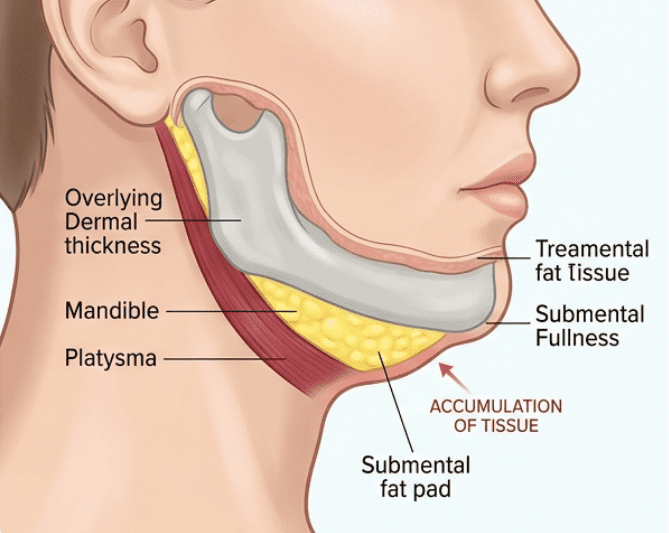
Clinically referred to as Submental Fullness, a double chin is an accumulation of tissue beneath the mandible (jawbone). While often associated with weight, it is a complex anatomical concern involving the submental fat pad, the platysma muscle, and the overlying dermal thickness.
Effective double chin treatment is not just about “removing fat.” It is about re-contouring the cervicomental angle (the angle between your neck and chin). This requires a dual focus: reducing volume and tightening the “skin envelope” so it hugs the new, slimmer contour of your jaw.
Submental Fullness Explained
What Causes a Double Chin?
A double chin is often the result of three distinct biological factors working together:
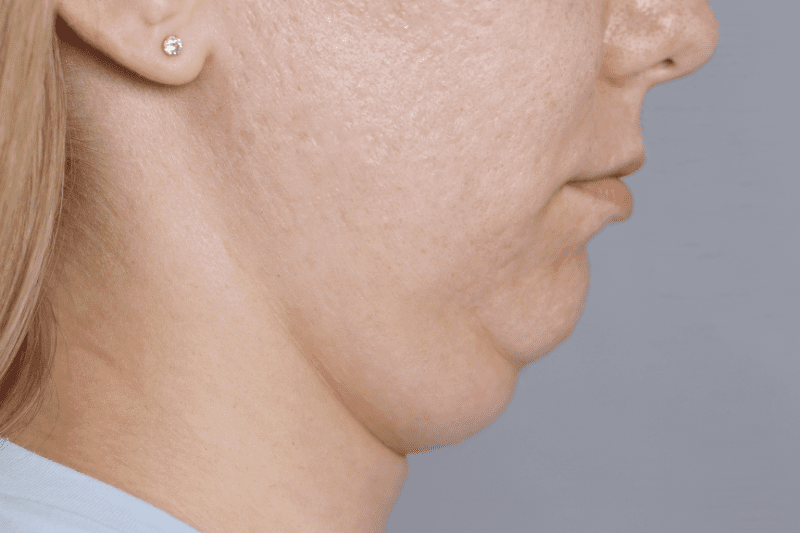
- Submental Fat Accumulation: Some individuals are genetically predisposed to storing “stubborn” fat in the submental compartment. This fat is often resistant to diet and exercise, meaning the pocket remains visible even at a low body fat percentage.
- Retrogenia (Weak Chin/Jaw Anatomy): If the lower jaw sits further back or is smaller, there is less skeletal support for the soft tissue. This causes the skin and fat to “bunch up” under the chin, creating the illusion of a double chin despite minimal fat.
- Skin Laxity & Gravity: As collagen and elastin levels decline, the skin loses its “recoil.” Gravity pulls this weakened tissue downward, causing it to sag and pool under the jawline, often referred to as “false submental fullness.”
- Deep Muscle Sagging: The platysma muscle (the thin muscle covering the neck) can become lax over time. When this muscle “drops,” it allows the underlying structures to bulge forward, distorting the sharp transition between the chin and the neck.
COncern level
Double Chin Treatments Tailored to Severity
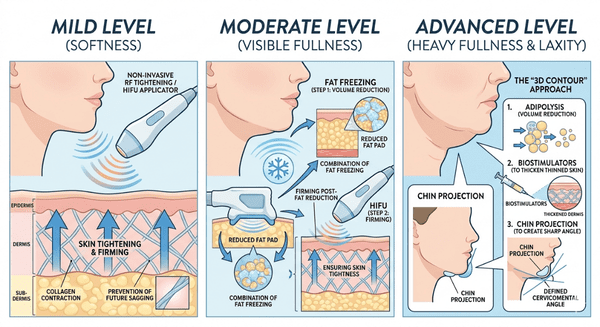
- Mild (Softness under the chin): Focus: Skin Tightening. Non-invasive RF Tightening or HIFU to firm the tissue and prevent future sagging
- Moderate (Visible fullness in profile): Focus: Volume Reduction + Firming. A combination of Fat Freezing to reduce the fat pad, followed by HIFU to ensure the skin doesn’t become “loose” after the fat is gone
- Advanced (Heavy fullness + Significant Laxity): Focus: The “3D Contour” Approach. A multi-modal plan involving Adipolysis (volume reduction), Biostimulators (to thicken thinned skin), and Chin Projection to create a sharp, defined cervicomental angle.
Treatment approach
Treating Double Chin: Fat, Loose Skin or Chin Shape
We categorize our clinical protocols based on whether the primary issue is Volume (Fat) or Structure (Skin/Muscle).
Category 1: Adipose (Fat) Reduction
Primary Concern: A physical pocket of fat that is soft to the touch.
- Cryolipolysis (Fat Freezing): Uses controlled cooling to target and eliminate fat cells without surgery. Once the fat cells are crystallized, the body naturally processes and removes them over several weeks.
- HIFU (Ultraformer MPT): While primarily for lifting, at specific depths, HIFU can achieve “Micro-focused Adipolysis,” breaking down small amounts of fat while simultaneously tightening the skin.
- Target: “Stubborn” fat pockets in patients with good skin elasticity.
Category 2: Structural Tightening & Lifting
Primary Concern: “Loose” or hanging skin that obscures the jawline.
- InMode Forma / RF Tightening: High-frequency thermal energy stimulates collagen contraction. This “shrink-wraps” the skin under the chin, pulling it tighter against the jawbone for a sharper profile.
- Target: Aging-related sagging or “crepey” skin under the chin.
Category 3: Profile Projection & Definition
Primary Concern: Lack of chin prominence causing tissue to bunch.
- Chin Fillers (Hyaluronic Acid): By strategically adding projection to the chin, we stretch the submental tissue forward. This often “smooths out” a double chin instantly by providing the skeletal support the skin was previously missing.
- Target: Patients with a “receding” chin or weak jawline definition.
FAQ
Frequently Asked Questions About Double Chin
Why do I have a double chin even if I am thin?
This is typically due to anatomy and genetics. You may have a genetically larger submental fat pad, or your jawbone structure (mandible) may be “short,” providing less surface area for the skin to drape over smoothly. Additionally, if you have naturally thin skin, even a small amount of fat or a slight loss of collagen can cause the area to look “heavy” due to a lack of structural tension.
What is the difference between a double chin and "loose skin"?
The “Pinch Test” is a simple indicator. If you can pinch a thick, soft cushion of tissue, the primary concern is likely fat (adipose). If the tissue you pinch is thin, papery, and slow to “snap back,” the issue is skin laxity (collagen loss). Most patients in Singapore have a combination, which is why a single-device approach often yields sub-optimal results.
Can "Jawline Fillers" alone fix a double chin?
In cases of Retrogenia (a weak chin), yes. Sometimes the “double chin” isn’t caused by fat, but by a lack of chin length. By adding 5-10mm of projection with a high-density filler, we physically pull the submental skin forward, effectively “stretching out” the fold. However, if there is a significant fat pad, fillers alone might make the lower face look “heavy.” A specialist assessment is required to decide if you need to “Reduce” (Fat) or “Replace” (Bone Support).
Is my double chin caused by my posture?
While posture doesn’t “create” fat, chronic “forward head posture” (leaning toward a laptop or phone) weakens the deep neck flexor muscles. Over time, this leads to a softening of the submental area and causes the skin to sag prematurely. Furthermore, poor posture compresses the soft tissue, making even a small amount of fat look twice as prominent. Improving your ergonomics helps, but once the “mechanical folds” are etched into the skin, clinical intervention is usually required to restore the original contour.
Will I have "saggy skin" after the fat is removed?
This is a common concern for patients over 30. If you only remove the fat (volume) without addressing the “skin envelope,” the skin may appear loose or “empty.” This is why our protocols often pair Fat Freezing or Adipolysis with RF Tightening or HIFU. By stimulating collagen production at the same time the fat is being metabolized, we ensure the skin “shrink-wraps” around the new, slimmer jawline contour.
Why aren't chin exercises or face yoga working?
“Face yoga” focuses on strengthening the muscles, but a double chin is typically a volume or skin envelope issue. You cannot “spot-reduce” fat by moving the muscle underneath it. In fact, over-exercising the neck muscles (like the platysma) can sometimes make vertical neck bands more prominent, which actually ages the neck. Clinical treatments like Cryolipolysis or HIFU target the adipocytes (fat cells) and dermal collagen, which no amount of exercise can physically alter.
Can a double chin come back after treatment?
The fat cells destroyed during treatments like Fat Freezing or HIFU are permanently removed. However, the remaining fat cells in your neck can still expand if there is significant weight gain. Think of treatment as “sculpting the foundation.” To maintain that sharp, 90-degree cervicomental angle, we recommend a stable weight and annual “maintenance” tightening sessions (like RF or HIFU) to combat the natural, ongoing process of collagen decline.
Does treating a double chin help with my "profile" in photos?
Absolutely. Many patients find that they look “heavier” than they are in photos because they lack a clear separation between the face and neck. By reducing the submental fat and sharpening the mandibular (jaw) line, we create a shadow play that defines the lower face. This provides a “slimming” effect for the entire facial profile without needing to treat the cheeks or mid-face.