


You have tried the eye creams. You have tried sleeping more. Concealer helps in the morning, but by mid-afternoon, under the office lights, the darkness is back. Somewhere along the way, a friend, a video or a clinic told you that under-eye filler is the one thing that really works.
For some people it does make a clear difference. For others it changes very little, and for a few it makes the under-eye look puffier or faintly blue. The difference isn’t luck, and it usually isn’t technique alone. It comes down to what is making the area look dark in the first place, because filler can only change one kind of darkness.
The short answer
Does filler help dark eye circles?
Only when the darkness is a shadow. Filler adds volume to a hollow tear trough, so less light falls into the groove and the shadow softens. It doesn’t change skin colour, so it can’t lighten brown pigment or hide blue-purple vessels showing through thin skin, and it doesn’t remove eye bags. Placed in the wrong case it can look bluish or puffy. Most dark circles are mixed, so the useful first step is working out which part is a shadow.
Colour or shadow? Why it matters for filler
“Dark circles”, or “dark eye circles”, describes how the under-eye looks, not what is causing it. Broadly, the darkness comes from one of two sources, and often both.
The first is colour in or beneath the skin. Brown or grey-brown pigment sits in the skin itself. A blue, purple or reddish tone usually comes from small blood vessels and muscle showing through skin that is among the thinnest on the body.
The second is shadow. With age, weight loss or simply the face you were born with, a groove can form where the lower eyelid meets the cheek: the tear trough. Light from above falls into that groove, and it reads as darkness even when the skin colour is completely normal.
Most people have more than one of these. In a study of 65 patients assessed with a Wood’s lamp and ultrasound, 78% had a mixed type. Purely pigmented, purely vascular and purely structural dark circles were all uncommon.¹ A study of 200 patients at Singapore’s National Skin Centre found a similar mix. Vascular and constitutional (inherited) pigment patterns were the most common, and a shadow effect was the main feature in only about one in nine.² ³
That matters because filler acts on shadow, and on nothing else. Our dark eye circles page explains all five layers we look at in an under-eye assessment. This article asks a narrower question: which of them can filler actually change?
What filler can and can’t change
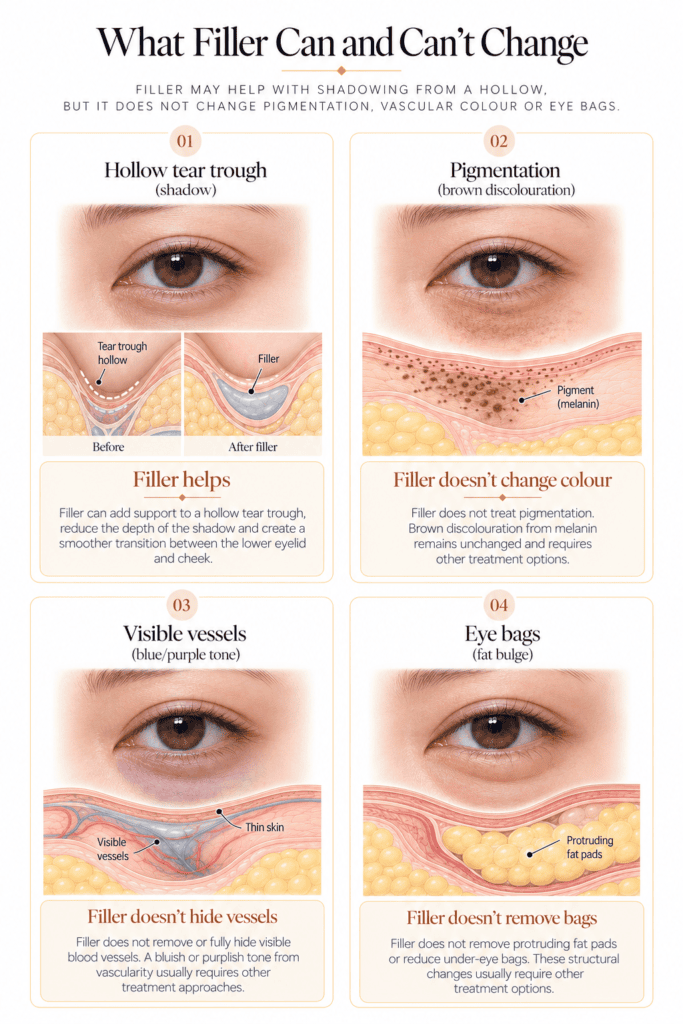
Under-eye filler is usually a hyaluronic acid gel, placed with a fine needle or cannula, mostly in a deep layer close to the bone. It restores some of the volume a hollow has lost. When the groove is shallower, less light falls into it and the shadow softens. That is the whole mechanism. It is a change in contour, and therefore in how light falls, not a change in the colour of the skin.
So filler can:
- Soften a shadow cast by a hollow tear trough.
- Smooth the transition between the lower eyelid and the cheek, which can make the eye look less tired.
Filler can’t:
- Lighten pigment. Brown or grey-brown colour stays the same colour, whatever is underneath it.
- Hide vessels showing through thin skin. If anything, product placed too close to the surface can add a bluish tone of its own (see below).
- Remove an eye bag. A bulge of fat pushing the lower lid forward isn’t a hollow, and adding volume next to it doesn’t take it away.
- Tighten crêpey or lax skin in any meaningful way. Doctors who treat this area note that very thin, inelastic skin often responds poorly to filler, and can even look worse.⁴
Where filler fits, and where it doesn’t
| What is making it look dark | Can filler change it? | What usually addresses it |
|---|---|---|
| A hollow tear trough casting a shadow | Yes. This is what filler is for | Volume restoration, often with attention to cheek support |
| A flat midface that no longer supports the lower lid | Partly. Treating only the groove may need more product than it should | Assessing the cheek and the lid–cheek junction together |
| Brown or grey-brown pigment | No | Settling irritation and rubbing, sun protection, and pigment-directed treatment such as picosecond laser in selected cases |
| Blue-purple tone from vessels under thin skin | No, and superficial filler can add a bluish tint | Skin-quality treatment; managing allergy and rubbing |
| An eye bag (fat bulging forward) | No. Filling around it can make the lower lid look fuller | Contour or skin treatment for mild cases; a surgical opinion for a true fat bulge |
| Puffiness or fluid that comes and goes | No, and it raises the risk of swelling after filler | Finding the cause of the fluid first |
| Thin, crêpey, lax skin | Limited | Skin-quality and collagen-stimulating approaches |
Based on references 1–6 and the AES 5-Layer Under-Eye Assessment. Not every option suits every person.
Read down the middle column and the pattern is clear. Filler answers one row well, one row partly, and none of the others. When someone has a mixed picture, which is most people, filler may be one part of a plan but rarely the whole of it.
Three ways filler can make dark circles look worse
When filler is used for a dark circle that isn’t mainly a shadow, the result can be disappointing. Sometimes it is worse than before. There are three common reasons.
1. A bluish tint. Hyaluronic acid placed too close to the surface of very thin skin can show through as a blue-grey hue. This is often called the Tyndall effect.⁴ ⁵ For someone whose dark circles were already partly vascular, that is the opposite of what they wanted. It is more likely when skin is fair and thin and when product sits superficially.⁴
2. Swelling that lingers. Hyaluronic acid holds water. The under-eye also drains fluid less freely than most of the face. Some swelling straight after treatment is common and usually settles: in one prospective study, almost all patients had mild swelling immediately afterwards, and 2 of 24 still had mild swelling at four weeks.⁶ But persistent puffiness along the tear trough has been reported in up to around one in ten treatments in some series. It can appear months or even years later as the gel breaks down into smaller, more water-attracting fragments.⁵ People who already have puffiness or fluid retention around the eyes appear to be at higher risk.⁴ ⁵
3. A bag looks bigger, or pigment becomes more obvious. If the main issue is a fat bulge, adding volume around it can make the whole lower lid look fuller rather than smoother. And when a shadow is lifted from an area that also has pigment, the pigment doesn’t go anywhere. One review notes that some patients with dark circles reported darker-looking pigmentation after hyaluronic acid filler.³ The filler hasn’t created pigment. The shadow was hiding some of it.
None of this means under-eye filler is a poor treatment. In well-chosen cases, satisfaction is generally good.⁶ It means the choice of patient matters as much as the injection itself. The under-eye is also a delicate area. Bruising is common, and serious complications from blocked blood vessels are rare but recognised with fillers anywhere on the face, which is why this treatment belongs in medical hands.⁷
Five clues to what is making your under-eyes dark
These clues can’t diagnose you. They are a way of looking more closely before you speak to anyone. Use a hand mirror and natural daylight, and look straight ahead without smiling.
1. Does it change with the light? Look under an overhead light, then face a window, then tilt your chin slightly up. A shadow from a hollow changes noticeably as the light moves and often almost disappears when light comes from the front. Pigment stays the same colour whatever the light does.³
2. What happens when you gently stretch the skin? Place a fingertip on your cheekbone and draw the skin very gently downwards. Pigment stays visible. A shadow lessens or goes. A blue-purple vascular tone tends to spread out without fading.³
3. What colour is it? Brown or grey-brown points to pigment. Blue, purple or pinkish points to vessels under thin skin. A grey darkness that sits exactly in a groove, with normal-coloured skin either side, points to shadow.¹ ³
4. Is there a bulge above the groove? If you see a soft fullness between the lashes and the groove, the shadow beneath it may be cast by an eye bag rather than a hollow. Many people notice it more first thing in the morning or when looking upwards. That changes the conversation entirely.
5. What’s your history? Darkness since childhood, or in several family members, suggests inherited pigment. Allergies, eczema and eye rubbing feed both pigment and vascular darkness. A shadow that appeared after losing weight, or that has deepened gradually with age, suggests a hollow. Puffiness that started after previous filler and never fully settled is worth having checked before anything else is added.
If clue 1 and clue 2 both point to shadow, filler may well be part of your answer. If they point to colour, it probably isn’t, however good the injector.
A sudden change on one side only, or swelling with redness, pain or changes in your vision, is not a cosmetic issue. Please see a doctor promptly.
If you’ve already had filler and it looks worse
If your under-eyes look bluish, puffy or lumpy after filler, or simply no better, it helps to know two things. First, hyaluronic acid filler can usually be dissolved with an enzyme called hyaluronidase, so most of these problems can be corrected.⁵ Second, adding more filler is rarely the right response to a result that looks puffy or blue.
What helps is a fresh look at what the darkness was in the first place, whether the filler is contributing to what you now see, and what the darkness underneath needs. The dark eye circles page explains why reassessment is often more useful than repeating the same treatment.
Key takeaway
Filler changes shape, not colour. It can soften a shadow cast by a hollow, but it can’t lighten pigment, hide vessels, remove an eye bag or tighten thin skin. Most dark circles are a mix, so the right question isn’t “Will filler work?” but “How much of my darkness is shadow?” The answer decides whether filler belongs in your plan, and where in the order it should come.
Why assessment comes before the syringe
Because most dark circles are mixed, a sensible plan usually treats one layer at a time and reviews in between. Irritated skin is settled before pigment is treated. A true eye bag is identified before anyone considers volume. When a hollow is part of the picture, filler may help, sometimes with attention to the cheek first so that less is needed under the eye.
Sometimes the most useful outcome of an under-eye assessment is being told that filler isn’t the right tool for you. Or that something else should come first. Or that a surgical opinion would serve you better. That isn’t a refusal to help. It is the difference between treating the darkness you have and treating the darkness someone assumed you had.
Not sure what’s making your under-eyes dark?
An under-eye assessment looks at pigment, vessels, skin quality, hollowing and eye bags, so you know which parts of your dark circles each treatment can change, and which treatments are unlikely to help you, before anything is decided.
Frequently asked questions
Will filler get rid of my eye bags?
No. An eye bag is a bulge, usually fat that has moved forward behind the lower eyelid. Filler adds volume, so it can’t remove a bulge. In mild cases, carefully softening the hollow below a small bag can make the transition look smoother, but that is camouflage, not removal.
When the bag is significant, adding volume around it tends to make the lower lid look fuller and heavier, and the underlying problem remains. For a true fat bulge, a surgical opinion is often the more honest conversation, and a good assessment will tell you if that applies to you.
Can filler make my dark circles darker?
It can make them look different in ways people experience as worse. Product placed too close to the surface of thin skin can show a bluish tint, which adds to a vascular dark circle rather than hiding it. Swelling, especially in people who are already prone to puffiness, can create a new shadow beneath it.
And when filler lifts a shadow from skin that also has pigment, the brown colour can look more obvious because the shadow was partly hiding it. These outcomes are much less likely when the darkness has been correctly identified as a shadow before treatment.
Is “under-eye filler” the same as “tear trough filler”?
There isn’t one fixed rule, and it depends on which part bothers you most and how your skin behaves. A common approach is to settle any irritation, rubbing or allergy first, because inflamed skin tends to darken further. The pigment and the hollow are then treated in a planned order, with time between steps to see what each one has changed.
Treating everything at once makes it hard to judge results and harder to identify the cause if something doesn’t go as expected. Your doctor should explain the order and the reasoning before you start.
My dark circles are part pigment, part hollow. What should be treated first?
It may be part of it. Losing facial fat can deepen a tear trough that was barely noticeable before, and that kind of shadow is the sort that responds to volume. But weight loss rarely affects only the under-eye. The cheeks and temples often change too, and treating the under-eye alone can look out of balance.
If your weight is still changing, it is usually sensible to wait until it has settled. If you are losing weight with a GLP-1 medication, our page on facial changes after weight loss explains how doctors look at the face as a whole.
My under-eyes look hollow since I lost weight. Is filler the answer?
Medical References
- Huang YL, Chang SL, Ma L, Lee MC, Hu S. Clinical analysis and classification of dark eye circle. International Journal of Dermatology. 2014;53(2):164–170. View published study
- Ranu H, Thng S, Goh BK, Burger A, Goh CL. Periorbital hyperpigmentation in Asians: an epidemiologic study and a proposed classification. Dermatologic Surgery. 2011;37(9):1297–1303.
- Sarkar R, Ranjan R, Garg S, Garg VK, Sonthalia S, Bansal S. Periorbital hyperpigmentation: a comprehensive review. Journal of Clinical and Aesthetic Dermatology. 2016;9(1):49–55. View published review
- Doran M. Treating tear trough deformities with dermal fillers. EyeNet (American Academy of Ophthalmology). November 2014:29–31.
- Murthy R, Roos JCP, Goldberg RA. Periocular hyaluronic acid fillers: applications, implications, complications. Current Opinion in Ophthalmology. 2019;30(5):395–400.
- Diwan Z, Trikha S, Etemad-Shahidi S, Alli Z, Rennie C, Penny A. A prospective study on safety, complications and satisfaction analysis for tear trough rejuvenation using hyaluronic acid dermal fillers. Plastic and Reconstructive Surgery Global Open. 2020;8(4):e2753. View published study
- Doyon VC, Liu C, Fitzgerald R, et al. Update on blindness from filler: review of prognostic factors, management approaches, and a century of published cases. Aesthetic Surgery Journal. 2024;44(10):1091–1104. View published study
About This Article
Medically reviewed by Dr. Jonathan Lee, Aesthetic Physician & Consultant Surgeon · Last reviewed October 2026
This article is for general education and does not replace a doctor’s consultation. Dark circles can’t be assessed reliably from photographs or descriptions, and treatment suitability and outcomes vary between individuals. If you notice sudden changes in your vision, severe pain around the eye or skin turning white, blue or purple after any injectable treatment, seek medical care immediately.