

At some point, the under-eye skin starts to look different. It’s finer, a little crêpey when you smile, slightly shadowed even after a good night’s sleep. Concealer settles into lines that weren’t there before. And somewhere between a friend’s recommendation and a scroll through social media, three options keep coming up: salmon DNA, PDLLA and hyaluronic acid skin boosters.
They’re often presented as rival versions of the same thing. They aren’t. Each is a different material, proposed to work in a different way, with a different amount of evidence behind its use around the eyes. And the under-eye area itself is rarely one problem. Before comparing materials, it helps to know what you’re actually trying to change.
The short answer
How do salmon DNA, PDLLA and hyaluronic acid skin boosters differ?
They’re different materials aimed at different parts of the problem. Polynucleotides (purified from salmon DNA) are studied mainly for fine lines and skin quality. PDLLA combined with hyaluronic acid adds microparticles proposed to stimulate gradual remodelling, with early, small studies under the eyes. Hyaluronic acid boosters mainly attract water and support hydration.
First, what is making the under-eye look tired?
Dark eye circles and a “tired” under-eye usually come from more than one source. In an under-eye assessment, we look at five layers that can each contribute to dark eye circles: pigment in the skin, blood vessels showing through, skin quality, structure (hollowing where the eyelid meets the cheek), and puffiness or eye bags.
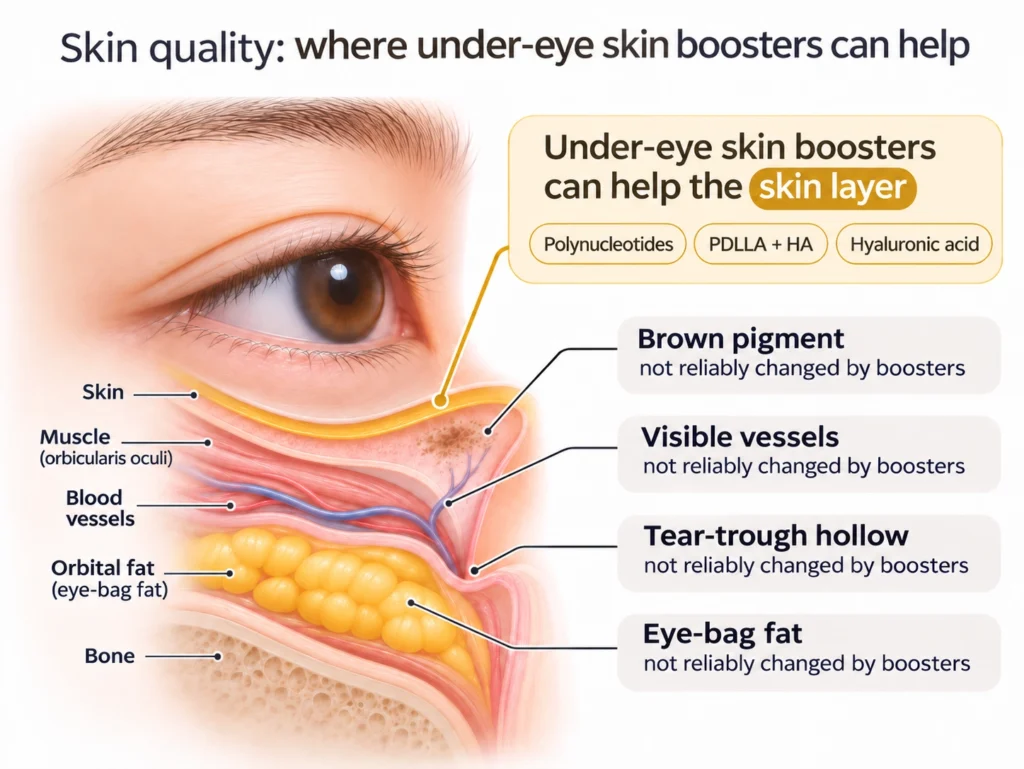
Skin boosters belong almost entirely to one of those layers: skin quality. And even skin quality isn’t a single thing. A doctor will usually separate:
- Dryness and dehydration lines: fine, criss-cross creasing that’s more noticeable when the skin is dry
- Thin, translucent or crêpey skin: skin that wrinkles like tissue paper and lets the colour of vessels show through
- Fine static lines: creases that stay when your face is relaxed
- Laxity: loose lower-eyelid skin that doesn’t spring back well
A skin booster may help with some of these. It won’t change brown pigment, lighten visible veins, fill a true hollow or remove an eye bag. That’s why two people having “the same treatment” can have very different experiences. They may have had different problems from the start.
Three kinds of skin booster at a glance
| Polynucleotides (PN, from salmon DNA) | PDLLA with hyaluronic acid | Hyaluronic acid (HA) skin boosters | |
|---|---|---|---|
| What it contains | Purified DNA fragments (polynucleotides) in a gel | Microparticles of poly-D,L-lactic acid (PDLLA) mixed with a small amount of non-crosslinked HA | Hyaluronic acid. Ranges from free-flowing (non-crosslinked) to lightly stabilised gels, depending on the product |
| What it’s proposed to do | Support skin hydration, elasticity and dermal quality; laboratory work suggests effects on tissue repair pathways | Act as a collagen-stimulating (biostimulator) material, with the HA giving an early hydrating effect | Bind water in the skin to support hydration and suppleness |
| Where it may fit, after assessment | Fine crêpiness and early skin-quality change, with little hollowing | Selected thin skin and texture change, and possibly a mild tear-trough irregularity | Dryness and fine dehydration lines, if the specific product suits the site |
| Main limitation under the eyes | Doesn’t restore deeper support, pigment or bags | A particulate material: it can’t be dissolved the way HA can, and lumps (nodules) are a recognised risk | Can hold water; in people prone to swelling, puffiness or visible irregularity is a concern |
| Evidence around the eyes | Several small randomised studies; one systematic review; follow-up no longer than 6 months¹ | Small uncontrolled studies only² | Mostly indirect; the one controlled under-eye comparison used a non-crosslinked HA³ |
Note what the table doesn’t do: it doesn’t rank them. There’s no robust trial comparing all three under the eyes, so any claim that one is simply “better” goes beyond the evidence.
Polynucleotides (salmon DNA): what’s been studied
Polynucleotides are chains of purified DNA fragments, most commonly derived from salmon or trout. They have the most direct research around the eyes of the three, though it’s still early.
A systematic review published in October 2026 pooled six studies of injectable polynucleotides around the eyes, involving 350 people. Five were randomised split-face trials. At 12 weeks, between 40% and 70% of treated sides improved by at least one grade for crow’s feet. That’s a range across different studies, not a single combined result. Measures of skin quality also improved. But every study was in Korean or Thai participants, most of them women, and none followed anyone beyond six months. The authors describe the findings as preliminary.¹
The most relevant head-to-head study treated 27 people with polynucleotide on one side of the eye area and a non-crosslinked hyaluronic acid on the other, three sessions two weeks apart. Overall, people’s and doctors’ ratings of improvement didn’t differ significantly between the two sides. Some skin measurements, including elasticity, hydration and roughness, improved more on the polynucleotide side.³ The study was small, partly funded by a polynucleotide manufacturer, and compared one particular kind of hyaluronic acid. So it doesn’t show that polynucleotides outperform every HA booster.
Two practical points. Not all polynucleotide (salmon DNA) skin boosters are the same: concentrations and formulations vary, so results from one can’t be assumed for another. And because they come from fish DNA, tell your doctor about any fish or seafood allergy beforehand.
PDLLA with hyaluronic acid: promising, but early
This combination pairs microparticles of poly-D,L-lactic acid (PDLLA) with a small amount of hyaluronic acid. In the formulation studied under the eyes, a vial contains 42.5 mg of PDLLA and 7.5 mg of non-crosslinked HA.² PDLLA belongs to the same broad family as other collagen-stimulating injectables. The idea is that the particles prompt the skin to remodel gradually, rather than simply adding volume.
The most useful under-eye study so far followed 15 women (average age 38) treated in Singapore and Malaysia. Each had three sessions a month apart. Doctors’ and patients’ ratings of the tear-trough area improved, as did scores for skin elasticity, hydration and radiance. Most participants had mild swelling lasting from a few hours to two days, and two had temporary bruising.² The authors themselves call it a “small uncontrolled pilot”. There was no comparison group, all participants were Asian women, and the manufacturer covered travel costs.
That makes a PDLLA with hyaluronic acid skin booster a reasonable option to discuss for some people, but it’s not yet well established. Two cautions matter more here than for the other two categories:
- It isn’t fully reversible. Hyaluronic acid can usually be dissolved with an enzyme if needed. PDLLA particles can’t, so a lump or irregularity may be harder to correct.
- Nodules are a recognised risk with particulate materials. A published case report described visible lumps under the eyes after a different, higher-dose PDLLA product.⁴ That can’t tell us how often this happens with the lower-dose formulation, but it’s why technique, dilution and patient selection matter.
PDLLA with HA is also not a replacement for structural filler. It may soften a mild irregularity. A true hollow is a different problem.
Hyaluronic acid boosters: it depends which hyaluronic acid
“Hyaluronic acid skin booster” covers a wide range of products, and the differences matter more under the eyes than almost anywhere else:
- Non-crosslinked HA: free-flowing and short-lived in the skin, used mainly for hydration
- Lightly crosslinked or stabilised HA boosters: gels designed to last longer in the skin and support elasticity. Each product has its own concentration, gel properties and approved treatment areas. One widely used stabilised HA booster, for example, lists the lower cheek, jawline and upper neck as its intended areas, not the lower eyelid.⁵
- Structural HA fillers: a different category altogether, designed to restore volume and support. They’re used for hollows, not skin quality, and carry their own site-specific risks. Whether filler suits a hollow tear trough depends on what else is contributing to the darkness.
Because hyaluronic acid attracts water, the main trade-off under the eyes is swelling. For someone whose lower eyelids already puff up in the mornings, or who has swelling over the upper cheek, a water-binding product can make that more noticeable. That’s one reason a doctor will ask about puffiness before suggesting any HA product here.
Which approach fits which under-eye?
These are examples of how the conversation might go in consultation, not treatment recommendations. Most people have more than one feature.
If the main issue is fine crêpiness with little hollowing, a skin-quality treatment such as polynucleotides, or a suitable HA booster, is usually the first thing to discuss. The evidence for both is short-term, and neither is proven better.
If dryness and fine dehydration lines dominate, a hydration-focused HA approach may be considered, alongside a simple, non-irritating skincare routine. The specific product and its approved areas matter.
If there’s a mild tear-trough dip as well as fine lines, two different things are going on. A doctor may discuss PDLLA with HA for selected cases, or treat contour and surface separately. The early evidence for PDLLA here isn’t yet strong enough to call it the standard approach.
If the darkness is mainly brown pigment or visible veins, none of these is usually the main treatment. Pigment is a colour problem (see what an eye cream can and can’t reach in dark eye circles). Vessels need their own assessment.
If the main issue is puffiness, eye bags or swelling over the cheekbone, an injectable booster is often the wrong first step and may make swelling more noticeable. The cause of the swelling, whether it’s fluid, fat or skin laxity, should be worked out first, and sometimes a surgical opinion is the right one.
If there are deeper etched lines or loose eyelid skin, an injectable alone is unlikely to be enough. Resurfacing, energy-based treatment or a surgical assessment may address it more directly.
Combining treatments makes sense only when there are genuinely separate problems, such as a structural hollow and surface crêpiness. It shouldn’t happen because several products each claim to “boost collagen”. There’s no evidence that stacking these three materials together around the eye works better.
How long do results last?
This is the question most people ask, and the honest answer is that the studies don’t yet tell us.
| Category | Longest follow-up in the under-eye studies | What that does and doesn’t mean |
|---|---|---|
| Polynucleotides | Up to 6 months¹ | Improvements were seen in the first months. Durability beyond that is unknown |
| PDLLA with HA | Around 3 months after a three-session course in the main cohort² | Early results are encouraging; they don’t show that effects last a year or more |
| Hyaluronic acid boosters | Short-term, and product-specific³ ⁵ | Duration depends on the exact formulation and can’t be borrowed from another product |
A suggested maintenance schedule (for example, every six or twelve months) isn’t the same as proof that one treatment lasts that long. And a material that stays in the skin longer isn’t automatically a better or safer choice.
Risks worth knowing about
Most side effects of skin boosters are mild and short-lived, but the under-eye is a delicate area.
- Common and temporary: stinging during injection, small bumps at injection points, redness, bruising and swelling for hours to days.
- Swelling that lingers: more likely in people who already have puffy lower eyelids or swelling over the cheekbones, and with water-binding products.
- Visible lumps or irregularities: the skin here is thin, so small irregularities can show. With particulate materials such as PDLLA, nodules can appear later and are harder to reverse.
- Rare serious complications: any injection near the eye carries a very small risk of a product entering a blood vessel. This is why anatomy, technique and the doctor’s experience matter.
- Small studies can’t rule out rare events. A study of 15 or 27 people reporting no serious problems is reassuring, but it can’t tell us how often uncommon complications occur.
Your doctor should also ask about previous fillers or eyelid surgery, any tendency to swell, allergies (including to fish or seafood), skin conditions around the eyes and your medicines before discussing suitability.
Key takeaway
Salmon DNA, PDLLA with HA and hyaluronic acid boosters aren’t three versions of the same treatment. They’re different materials that may help different parts of under-eye skin quality, each with early, short-term evidence. None treats pigment, veins, true hollows or eye bags, and none has been proven better than the others under the eyes. The most useful first step isn’t choosing a material. It’s finding out which layer is responsible for what you see.
Questions worth asking before treatment
A good consultation should leave you able to answer these:
- What exactly is the main problem under my eyes? Is it skin quality, structure, pigment, vessels, swelling, or a combination?
- Which category of material is being suggested, and why that one for me?
- Is that specific product intended for use in the lower eyelid? Approved treatment areas differ between products.
- What has it actually been studied for, and for how long?
- How many sessions are likely, and what happens if I don’t see a change?
- What would happen if I developed swelling or a lump, and can it be reversed?
- Is anything else, such as pigment, puffiness or loose skin, better treated another way?
Sometimes the answer to the last question changes the whole plan. For some people, a skin booster is a sensible part of it. For others, it turns out not to be needed at all.
Considering a skin booster for the under-eye area?
An under-eye assessment looks at pigment, vessels, skin quality, hollowing and puffiness, so you know whether an injectable is the right tool for what you see, and which kind, if any, would suit you. If you’d rather read first, you can see how dark eye circles are assessed and treated layer by layer before you book.
Frequently asked questions
How many sessions are usually needed?
There’s no reliable answer yet, because no robust study has compared them directly under the eyes. Polynucleotides (salmon DNA) have more controlled research around the eyes, mostly for crow’s feet and skin-quality measures over a few months. PDLLA with hyaluronic acid has smaller, uncontrolled studies that look encouraging, particularly for thin skin and mild tear-trough irregularity.
They work differently and carry different trade-offs. PDLLA particles, for example, can’t be dissolved if a lump forms. The better question is which one suits the specific problem your doctor finds, and what the evidence shows for that use.
Can skin boosters remove dark eye circles?
Not usually. PDLLA with hyaluronic acid is designed mainly to improve skin quality, and in small studies it softened mild tear-trough irregularity. A true hollow, where the lower eyelid meets the cheek with a clear groove and shadow, is a structural problem, and structural filler (or sometimes surgery) is the tool designed for it.
Some people have both a mild hollow and thin skin, and their doctor may discuss treating each separately. It’s worth being cautious about any suggestion that one injectable does everything under the eye.
Is salmon DNA or PDLLA better for under-eye wrinkles?
They can, particularly in people who are already prone to swelling. Hyaluronic acid attracts water, and the lower eyelid drains fluid slowly, so some people notice puffiness that lasts longer than the usual day or two.
If your eyes are puffy in the mornings, you have swelling over your cheekbones, or you have visible eye bags, mention it before treatment. In those cases a booster may not be the right first step, and the cause of the puffiness, whether fluid, fat or skin laxity, needs working out first.
Can a PDLLA skin booster replace tear-trough filler?
Only the part of the darkness that comes from skin quality. If thin, crêpey skin is letting the colour of underlying vessels show through, improving skin quality may soften that a little. But brown pigment, prominent veins, a shadow from a hollow tear trough and eye bags are all different problems, and a skin booster doesn’t reliably change any of them.
Most dark eye circles involve more than one of these, which is why an assessment of all the layers comes before choosing any treatment.
Can skin boosters make under-eye puffiness worse?
Medical References
- Ahuja R, Khalil S, Galadari HI, Guida S. Efficacy of polynucleotides in peri-orbital rejuvenation: a systematic review. Aesthetic Surgery Journal Open Forum. Published online 10 October 2026. View published review
- Young SM, Lau EKH. Hybrid biostimulator and hyaluronic acid injectable for tear trough rejuvenation. Aesthetic Plastic Surgery. 2026;50:5337–5343. View published study
- Lee YJ, Kim HT, Lee YJ, et al. Comparison of the effects of polynucleotide and hyaluronic acid fillers on periocular rejuvenation: a randomized, double-blind, split-face trial. Journal of Dermatological Treatment. 2022;33(1):254–260. View published study
- Energy-based device management of nodular reaction following poly-D,L-lactic acid injection for tear trough rejuvenation. Journal of Cosmetic Dermatology. 2025;24(1):e16575. View published case report
- Manufacturer’s Instructions for Use, stabilised hyaluronic acid skin booster (hyaluronic acid 12 mg/mL with lidocaine). 2023.
About This Article
Written by Dr. Jonathan Lee, Aesthetic Physician & Consultant Surgeon · Last updated November 2026
This article is for general education and does not replace a doctor’s consultation. It describes categories of injectable materials, not specific products, and does not recommend any product. Suitability, product selection and the risks of injectable treatment around the eyes depend on an in-person assessment, and results vary between individuals.


