


If you’re considering poly-L-lactic acid (PLLA) collagen-stimulating injections, you’ve probably come across different recommendations for how many sessions and vials you might need.
Someone you know may have completed three sessions. Another person might have needed six vials. You may even have heard of the popular rule suggesting one vial for every decade of your age.
But how much of that applies to your face?
While these numbers can be useful reference points, the right treatment plan depends less on a formula and more on understanding what has changed in your face, and what you’re trying to achieve.
The short answer
How many sessions and vials of PLLA will I need?
Most facial PLLA treatment plans involve two to three sessions, spaced several weeks apart, often using one to two vials per session. Some patients may need more or fewer, depending on the degree of facial volume loss, areas treated and individual response to collagen stimulation.
These are general estimates, not fixed requirements. The number of vials determines how much product is used, while the number of sessions determines how treatment is distributed over time.
How many PLLA sessions will I need?
Most patients undergo two to three PLLA sessions, typically spaced four to six weeks apart. A fourth session may be considered for more extensive volume loss or when additional correction is appropriate.
But why not complete everything in one appointment?
Unlike treatments that provide immediate volume replacement, PLLA encourages your skin to produce collagen gradually. Spacing sessions gives those changes time to develop before your doctor decides whether further treatment is needed.
The benefit is greater control over the final result. Rather than committing to the full amount upfront, treatment can be adjusted according to how your face responds, helping to avoid unnecessary correction.
A full course generally takes a few months, with improvements continuing to develop after the final session.
How many vials will I need?
A vial of PLLA isn’t like a syringe of filler. It doesn’t hold a fixed amount of volume. Think of it instead as a dose of collagen stimulation: what it achieves depends on how your own skin responds.
For the face, one or two vials per session is common. Your total over the whole course depends on a few things.
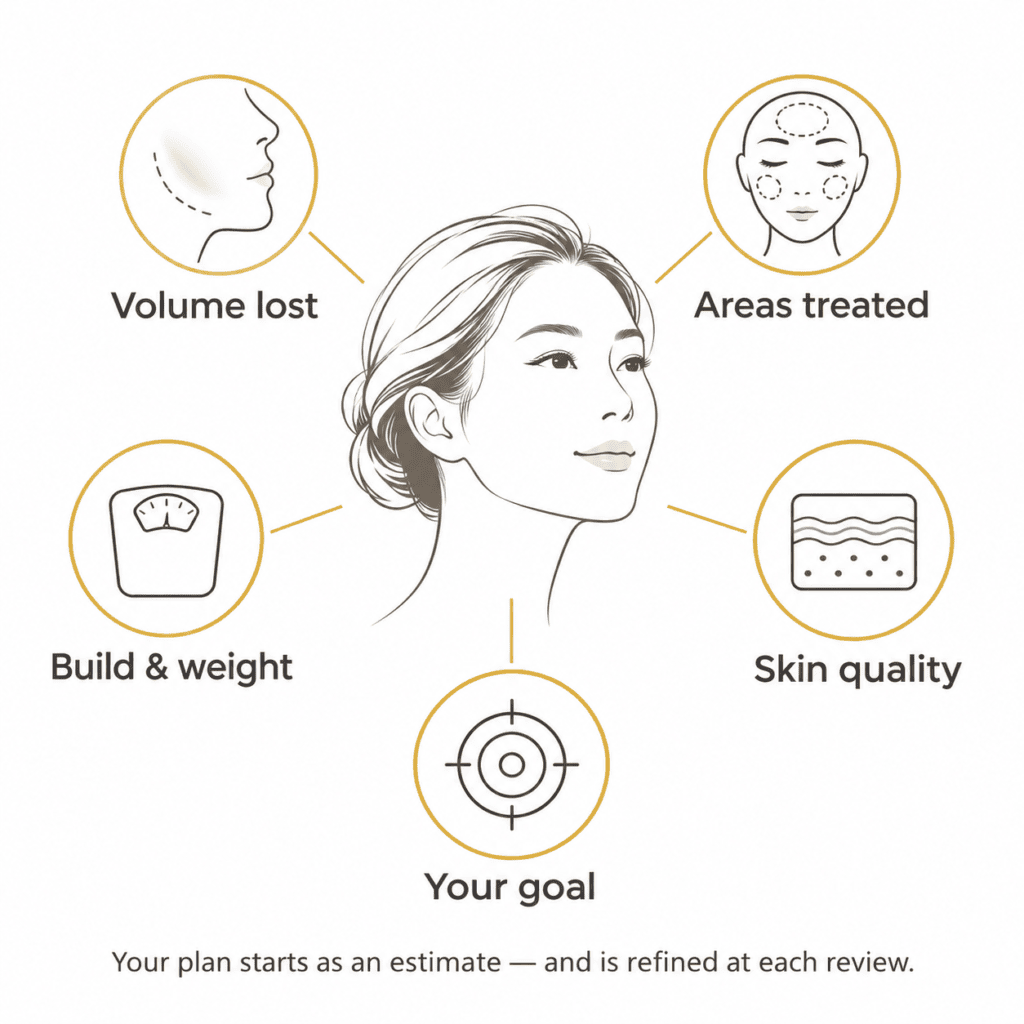
- How much volume has been lost. Early flattening needs less than marked hollowing.
- How many areas are treated. The temples alone need less than the temples, cheeks and jawline together.
- Your build and weight. A naturally lean face, or one that has changed after weight loss, often needs more support. If you’re still losing weight, including on GLP-1 medication, it’s often better to wait, and PLLA planning after GLP-1 weight loss works a little differently.
- Your skin. Thinner, sun-damaged skin has less to work with.
- What you want. A subtle refresh needs less than restoring structure that has visibly gone.
If your main concern is loose or sagging skin rather than lost volume, more vials won’t fix it, and treatments aimed at skin laxity may help more.
How we plan your PLLA sessions and vials
Dr. Jonathan Lee, Medical Director of The Aesthetic Studio Clinic, has over 25 years of clinical experience and was among the early adopters of PLLA treatment in Singapore. He also trains other doctors in the use of collagen-stimulating injectables.

His approach begins with understanding the face rather than deciding on a predetermined number of vials.
Not all facial volume loss occurs in the same areas, and not every hollow or contour change needs to be corrected to the same degree.
During assessment, Dr. Lee considers where volume has been lost, how the surrounding tissues are supported, and which areas would benefit most from treatment.
This helps establish not just how much product may be appropriate, but also where it should be used and how treatment should be paced.
As collagen stimulation develops, subsequent sessions can be adjusted according to the response. In some cases, this may mean less treatment than initially anticipated.
The aim is not to use a particular number of vials, but to achieve an appropriate degree of correction while preserving the individual’s facial proportions.
The ‘one vial per decade’ rule: how reliable is it?
You may have heard the recommendation that you need one vial of PLLA for every decade of your age: three vials at 30, five at 50, and so on. It’s an easy formula to remember, but it isn’t a medical dosing guideline.
Age-related volume loss is one consideration, but age alone tells us very little about where that loss has occurred or how much correction is appropriate.
Consider two people: a 38-year-old who has experienced significant facial volume loss after weight reduction, and a 58-year-old who naturally retains fuller cheeks and temples.
The younger person may have greater volume-related concerns despite being two decades younger.
Similarly, someone looking to address one small area may require considerably less product than someone planning treatment across multiple facial regions.
The one-vial-per-decade rule doesn’t account for these differences. Nor does it explain how many sessions are appropriate.
Why your treatment plan may change along the way
An initial estimate is useful for planning, but it shouldn’t mean committing to the same quantity of product at every appointment.
PLLA works through a gradual biological response, and the amount of correction can vary between individuals.
At each review, Dr. Lee reassesses the changes before determining the next step.
If the response is progressing well, fewer additional vials or sessions may be needed.
If further correction is appropriate, another session or additional treatment in selected areas may be considered.
If your facial volume changes or you’re satisfied with the improvement, the plan may be paused or revised.
This flexibility is especially important with PLLA. Unlike hyaluronic acid fillers, PLLA cannot simply be dissolved with hyaluronidase if too much has been administered.
The goal is therefore to build towards an appropriate result, rather than assuming that more product will produce a better one.
Wondering how many sessions and vials your face actually needs?
The right treatment plan starts with understanding your face, not choosing a number of vials.
If you’re considering PLLA, an assessment with our doctor looks at what your face has lost, whether PLLA collagen stimulation is the right tool, and roughly how many sessions and vials would make sense for you.
Frequently asked questions
Is one vial of PLLA enough?
For some patients, one vial per session may be appropriate, particularly for limited treatment goals or early volume loss in one area. However, one vial in total is unlikely to restore more noticeable volume loss across several areas of the face.
Our doctors will advise how many vials may be appropriate after assessing your face and what you would like to achieve.
Is one session of PLLA enough?
One PLLA session may be sufficient for some limited treatment goals, but most patients undergo two to three sessions. Multiple sessions allow collagen changes to develop and give your doctor an opportunity to reassess whether further correction is needed.
When will I see results from PLLA?
Some fullness may be visible immediately after treatment, but this is mainly due to the fluid used and usually settles within a few days. Visible improvement then develops gradually as collagen production increases.
Most patients notice changes over the following weeks to months, with the full effect typically seen around three to six months after treatment.
Can I have all my vials in one session?
Generally, no. PLLA is generally administered in staged treatments because its effects develop gradually. Giving too much product before assessing the response may increase the risk of overcorrection and certain complications, including nodules.
Our doctors will determine the appropriate quantity per session based on your facial anatomy and treatment plan.
How far apart are sessions, and how long does the whole course take?
PLLA sessions are commonly spaced four to six weeks apart, although intervals may vary according to the product guidance and individual treatment response.
A two- to three-session course generally takes a few months, with collagen remodelling continuing after treatment is completed.
About This Article
Medically reviewed by Dr. Jonathan Lee, Aesthetic Physician & Consultant Surgeon · Last reviewed November 2026
This article is for general education and does not replace a doctor’s consultation. PLLA treatment requirements and outcomes vary between individuals. The appropriate number of sessions and vials can only be determined following a clinical assessment.