
Most people with dark eye circles have a drawer that tells the story: a caffeine roller, a vitamin C serum, a “brightening” balm that came highly recommended, half a jar of something expensive that promised visible results in four weeks. Each one seemed to help a little at first, then didn’t. Sometimes nothing changed at all.
That isn’t because you chose the wrong brand. Dark eye circles are not one problem, and most of what makes the under-eye look dark sits where no cream can reach. Some eye creams do help some people. The useful question is whether the kind of darkness you have is one a cream can change.
The short answer
Do eye creams work for dark eye circles?
Sometimes, and only for some types. Creams act on the skin’s surface, so they may slowly soften mild brown pigment or a little of the bluish tone from thin skin over two to three months. They can’t fill a hollow, remove an eye bag or change bone structure, which cause much of the darkness people see. Evidence for eye-cream ingredients comes from small, short studies, and an irritating cream can make dark circles darker.
Why one cream can’t fix every dark circle
“Dark eye circles” describes how the area looks, not what causes it. Under the same name sit several different things: brown or grey-brown pigment in the skin; a blue-purple tone from blood vessels showing through very thin skin; a shadow cast by a hollow tear trough or a bulging eye bag; and thin, crêpey skin that lets more of everything show through.
Most people have more than one. In a study of 65 patients examined with a Wood’s lamp and ultrasound, 78% had a mixed type.¹ A study of 200 patients at Singapore’s National Skin Centre found vascular and constitutional (inherited) pigment patterns to be the most common, often overlapping, with shadow as the main feature in about one in nine.² ³
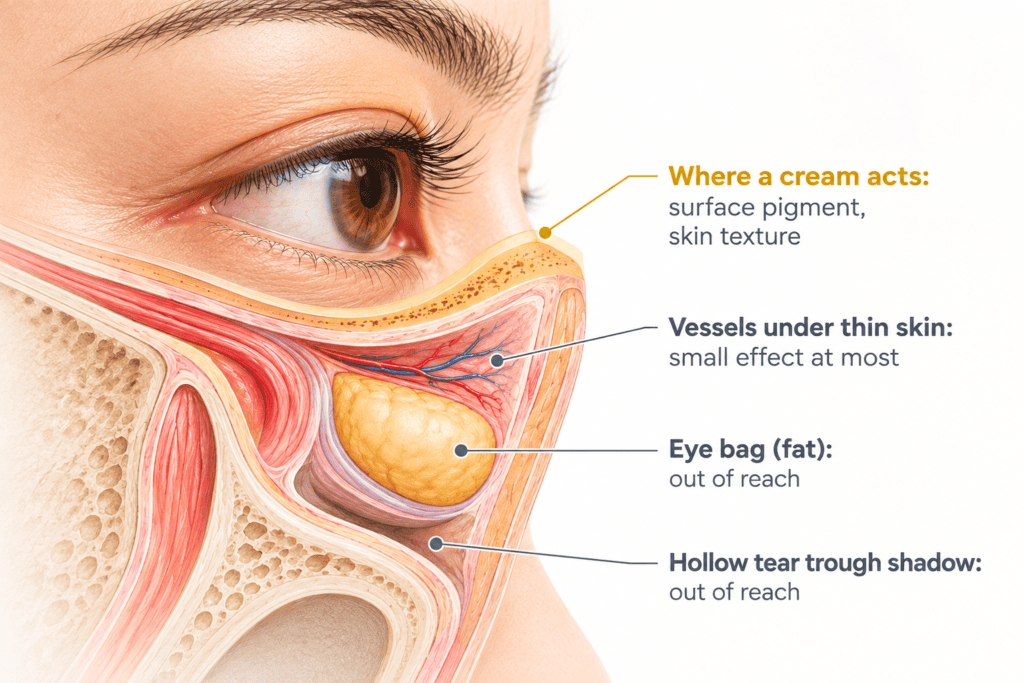
This matters for eye creams because a cream only meets the top layers of skin. It can influence colour that sits in the skin. It has little or no effect on what sits beneath it, and none on contour. In an under-eye assessment, we look at five separate layers that contribute to dark eye circles, from pigment and vessels to hollowing and eye bags. The skincare question is narrower: which of those layers can a cream actually change?
| What is making it look dark | Can a cream change it? | Ingredients with some evidence | What to realistically expect |
|---|---|---|---|
| Brown or grey-brown pigment, especially after rubbing, eczema or sun | Partly | Vitamin C and its derivatives, azelaic acid, arbutin, kojic acid, retinoids; prescription lightening agents under medical supervision | Gradual softening over months, not removal. Inherited pigment that has been there since childhood responds least |
| Blue-purple tone from vessels under thin skin | Slightly | Vitamin K, caffeine, vitamin C (thought to work through skin thickness rather than the vessels) | Small changes in small studies; often hard to see in a mirror |
| Thin, crêpey skin | Slightly, slowly | Retinoids, vitamin C | Modest improvement in texture over months; won’t hide strong vessel colour |
| Shadow from a hollow tear trough | No | None | No cream can add volume. Whether filler suits a hollow tear trough depends on what else is going on |
| An eye bag casting a shadow | No | None (caffeine may make morning puffiness look briefly less obvious, but the evidence is thin) | The bulge is fat behind the eyelid, out of a cream’s reach |
| Darkness from irritation or rubbing | Yes, indirectly | A plain, fragrance-free moisturiser, and stopping whatever is irritating the skin | Often the most worthwhile change a cream routine can make |
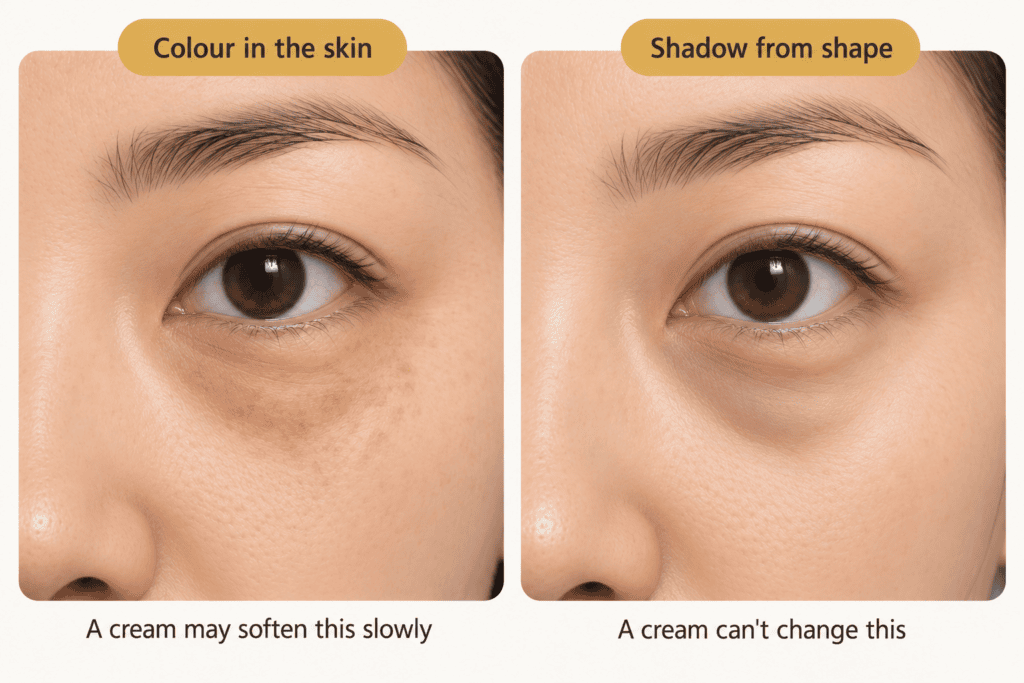
Read down the second column and the pattern is clear. Creams can help with colour that sits in the skin, a little. Shape, they can’t touch. That’s why a cream that works well for one friend does nothing for another: they may have different dark circles.
What the evidence actually shows
Eye-cream marketing often says “clinically tested”. It helps to know what that usually means for this area. Most published studies on under-eye ingredients are small, short and sometimes uncontrolled. Here are three of the better-known examples:
- Vitamin C. In a six-month split-face trial, 14 people applied a 10% vitamin C (sodium ascorbate) lotion under one eye and a plain lotion under the other. The treated side showed less darkening from congested blood, and the skin tended to be thicker, although that difference wasn’t statistically significant. A second vitamin C form tested in the same trial showed no meaningful difference. The authors thought vitamin C helped by thickening the skin and hiding the colour of the blood beneath it, not by lightening pigment.⁴
- Vitamin K with retinol and vitamins C and E. In an eight-week study, 57 adults used a combination gel twice a day. Fewer than half (27 of 57) showed a reduction in the blood-related darkness, and the authors noted that pigment was not clearly removed. There was no comparison group.⁵
- Caffeine with vitamin K. In a four-week study, 11 women used an under-eye pad containing 3% caffeine and 1% vitamin K under one eye and a water-only pad under the other. The authors reported less darkness and fewer fine lines on the treated side, but the published summary gave no figures for the size of the change.⁶
None of these studies is worthless. Together they suggest that some ingredients can make a modest difference to the vascular and thin-skin parts of dark circles if they’re used consistently for months. A Korean review of dark-circle treatments put it plainly: most topical agents “require a long period to achieve good results”, and they can irritate the sensitive skin around the eyes.⁷
For pigment, the strongest lightening agents, such as hydroquinone and tretinoin, are prescription medicines rather than cosmetic ingredients. They have been used around the eyes under medical supervision.³ But they need careful selection, and they can irritate or even darken skin when used without supervision (see below).
How an eye cream can make dark circles darker
This is the part most eye-cream advice leaves out. Eyelid skin is among the thinnest on the body and is particularly sensitive to irritants and allergens.⁸ Eye creams, moisturisers, sunscreens and makeup are all recognised causes of eyelid contact dermatitis, and that inflammation can be followed by post-inflammatory pigmentation: a new layer of darkness on top of whatever you started with.⁸
It usually happens in one of four ways:
1. An allergy or irritation to the cream itself. Fragrance, preservatives and some botanical extracts are common culprits. An allergy can appear after weeks or months of using a product you previously tolerated.⁸ Mild itching, dryness, flaking or a sting on application is your skin telling you something.
2. Strong actives used too often. Retinoids and acids can sting and peel the under-eye. Repeated irritation can leave the skin darker, especially in Asian skin, which is prone to pigment after inflammation.³ ⁷
3. Rubbing. Massaging creams in firmly, rubbing tired or itchy eyes and removing eye makeup with force all add friction, and friction is a recognised cause of under-eye pigment.³
4. Unregulated “whitening” products. In Singapore, hydroquinone and tretinoin are prohibited in cosmetic skincare and should only be used under medical supervision.⁹ The Health Sciences Authority has repeatedly found cosmetic creams, often bought online or overseas, that contain undeclared potent ingredients, including high levels of mercury.⁹ A cream that lightens very quickly is a reason for caution, not confidence.
If your under-eyes became darker, drier or itchier after starting a new product, stop it and let the skin settle before trying anything else. If it doesn’t settle within a couple of weeks, have it looked at.
Getting the most from an eye cream
If your dark circles are mainly pigment, mildly vascular or linked to thin, dry skin, a sensible skincare routine is worth doing well. These principles matter more than the brand:
- Match the ingredient to the darkness. Use the table above. If your darkness is mainly a shadow, save your money.
- Keep it simple and fragrance-free. One well-tolerated product beats a layered routine of several actives.
- Try new products on a small area first, and use them for several days before applying them across both under-eyes.
- Apply gently. Dab a small amount with your ring finger on the bony rim below the eye, staying away from the lash line. Don’t massage hard.
- Protect from light. Broad-spectrum sunscreen and UV-protective sunglasses are recommended for pigment around the eyes.³ Some people find mineral sunscreens less irritating close to the eyes. Singapore’s UV is high all year, so this isn’t seasonal.
- Deal with the triggers. Allergies, eczema and eye rubbing feed both pigment and vascular darkness. Treating them often does more than any cream.³
- Give it time, then judge honestly. Most studies ran for two to six months.⁴ ⁵ Take a photo in the same light before you start. If there’s no visible change after about three months of consistent use, the cream is unlikely to be the answer for you.
Five signs it’s time to stop buying eye creams
These signs can’t diagnose you. They suggest that the darkness may be coming from somewhere a cream doesn’t reach.
1. You’ve used a suitable product consistently for three months, with no change. Topical ingredients work slowly, but they shouldn’t take forever. A fourth or fifth product is unlikely to succeed where three have failed.
2. The darkness changes with the light. If it deepens under overhead lights and almost disappears when you face a window, much of it is shadow, and shadow is about contour, not colour.
3. There’s a soft bulge above the dark line. A shadow beneath an eye bag isn’t a skin colour problem. No cream will change it.
4. Gently stretching the skin doesn’t lighten it, and it looks blue or purple. That suggests vessels showing through thin skin. Creams make, at best, small changes here.
5. The skin is itchy, flaky or stings when you apply products. The routine may be adding to the darkness. Settling the skin comes before trying to lighten it.
If two or more of these apply, a cream is probably treating the wrong layer. And if shadow seems to be the bigger part of your darkness, it’s worth understanding why filler only helps one kind of dark circle before you consider it.
A sudden change on one side only, darkness with swelling or pain, or any change in your vision isn’t a skincare question. Please see a doctor promptly.
Key takeaway
An eye cream works on colour in the skin, not on shape. It can modestly soften mild pigment or the effects of thin skin over months, and a gentle routine with sun protection is worth keeping. It can’t fill a hollow or remove an eye bag, and an irritating cream can add pigment of its own. If the darkness hasn’t shifted after about three months, the question isn’t which cream to try next, but what kind of darkness you have.
What an under-eye assessment adds
The value of an assessment isn’t access to a stronger cream. It’s knowing which layers are involved, so that each one is treated with something that can actually reach it.
For some people, the answer really is skincare: a simpler routine, sun protection, allergy control and, where appropriate, a medical-grade lightening plan supervised by a doctor.
For others, the main issue turns out to be a hollow, an eye bag or vessels showing through thin skin. Skincare can then play a supporting role, alongside treatments such as picosecond laser for selected pigment, skin-quality treatment or volume restoration, or a surgical opinion for a true fat bulge. And sometimes the most useful advice is to stop a product that is irritating the skin and let it settle before anything else is considered.
Either way, you leave knowing what you’re dealing with, which is something no product label can tell you.
Tried several creams without much change?
An under-eye assessment looks at pigment, vessels, skin quality, hollowing and eye bags, so you know which parts of your dark circles skincare can realistically change, and what else, if anything, would help. If you’d rather read first, you can see how each type of dark eye circle is treated before you book.
Frequently asked questions
Which eye cream ingredient is best for dark circles?
There isn’t a single best ingredient, because “dark circles” covers several different problems. For brown pigment, lightening ingredients such as vitamin C, azelaic acid, arbutin, kojic acid and retinoids are the usual options, with stronger prescription agents used only under medical supervision. For a bluish tone from thin skin, vitamin C, vitamin K and caffeine have small studies behind them, and retinoids may slowly improve skin quality.
For a hollow or an eye bag, no ingredient makes a real difference. The more useful first step is working out which type you have. Choosing an ingredient before that is largely guesswork, and it’s why so many people end up with a drawer of half-used creams.
Can I use retinol under my eyes for dark circles?
Many people can, but the under-eye is where retinoids are most likely to sting, flake and irritate. Repeated irritation can leave the skin darker, especially in Asian skin. If you want to try it, use a low-strength product designed for the eye area, start two or three nights a week, apply it to the bony rim rather than close to the lashes, and stop if your skin becomes red, dry or itchy.
Retinoids work slowly, mainly on skin texture and fine lines, so judge them over months rather than weeks. Avoid them if you are pregnant or breastfeeding unless your doctor has advised otherwise, and talk to a doctor first if you have eczema around the eyes.
Is hydroquinone safe to use under the eyes?
Hydroquinone is one of the most studied lightening agents, and it has been used around the eyes under medical supervision. In Singapore it isn’t permitted in cosmetic skincare. It is used in prescription medicines because it can irritate skin, cause rashes and burning, and, with prolonged or inappropriate use, change skin colour.
That is why it’s best used only after a doctor has confirmed that the darkness is pigment and that it suits your skin, with a defined plan and review. Be especially wary of “whitening” eye creams bought online or overseas: the Health Sciences Authority has found products like these containing undeclared potent ingredients.
Do caffeine eye creams help dark circles and puffiness?
Caffeine is a popular eye-cream ingredient, and some people notice that their under-eyes look a little less puffy in the morning after using it. But the evidence that it changes dark circles is limited to very small, short studies, usually in combination with other ingredients such as vitamin K.
If your darkness is mainly a shadow from an eye bag or a hollow, caffeine won’t change the structure behind it. If puffiness comes and goes, it’s often worth looking at sleep position, allergies, salt and alcohol, and having persistent swelling checked, rather than relying on a cream.
Can an eye cream fix a tear trough or hollow under my eyes?
No. A tear trough is a groove where the lower eyelid meets the cheek. The darkness you see there is a shadow, caused by light falling into the hollow rather than by the colour of the skin. Creams can’t add volume, so they can’t change that shadow, however good the ingredients.
Hydrating creams can make the skin surface look smoother for a few hours, which some people find helpful under makeup, but the groove remains. If a hollow is the main cause of your dark circles, volume restoration may be worth discussing, although filler isn’t the right answer for every under-eye hollow.
Is concealer a reasonable option while I work out what’s causing my dark circles?
Yes. Makeup camouflage is a legitimate way to manage dark circles, and for some people it’s all they want. A colour corrector that matches the undertone of the darkness (peach or orange tones for blue-purple or brown) under your usual concealer often works better than a heavier layer of concealer alone.
Choose a product that doesn’t irritate your skin, apply it by patting rather than rubbing, and remove it gently at night. If your under-eyes become itchy or flaky, a makeup product may be the cause, and it’s worth stopping it to see whether the skin settles.
Medical References
- Huang YL, Chang SL, Ma L, Lee MC, Hu S. Clinical analysis and classification of dark eye circle. International Journal of Dermatology. 2014;53(2):164–170. View published study
- Ranu H, Thng S, Goh BK, Burger A, Goh CL. Periorbital hyperpigmentation in Asians: an epidemiologic study and a proposed classification. Dermatologic Surgery. 2011;37(9):1297–1303.
- Sarkar R, Ranjan R, Garg S, Garg VK, Sonthalia S, Bansal S. Periorbital hyperpigmentation: a comprehensive review. Journal of Clinical and Aesthetic Dermatology. 2016;9(1):49–55. View published review
- Ohshima H, Mizukoshi K, Oyobikawa M, et al. Effects of vitamin C on dark circles of the lower eyelids: quantitative evaluation using image analysis and echogram. Skin Research and Technology. 2009;15(2):214–217. View published study
- Mitsuishi T, Shimoda T, Mitsui Y, Kuriyama Y, Kawana S. The effects of topical application of phytonadione, retinol and vitamins C and E on infraorbital dark circles and wrinkles of the lower eyelids. Journal of Cosmetic Dermatology. 2004;3(2):73–75. View published study
- Ahmadraji F, Shatalebi MA. Evaluation of the clinical efficacy and safety of an eye counter pad containing caffeine and vitamin K in emulsified Emu oil base. Advanced Biomedical Research. 2015;4:10. View published study
- Park KY, Kwon HJ, Youn CS, Seo SJ, Kim MN. Treatments of infra-orbital dark circles by various etiologies. Annals of Dermatology. 2018;30(5):522–528. View published study
- Ryder E. Eyelid contact dermatitis. DermNet. Updated 2024. View article
- Health Sciences Authority, Singapore. HSA alert: 18 cosmetic products detected to contain potent undeclared ingredients including high levels of mercury. Accessed October 2026. View HSA alert
About This Article
Medically reviewed by Dr. Jonathan Lee, Aesthetic Physician & Consultant Surgeon · Last reviewed October 2026
This article is for general education and does not replace a doctor’s consultation. Dark circles can’t be assessed reliably from photographs or descriptions, and ingredients mentioned are described as categories, not product recommendations. If a skincare product causes redness, itching, swelling or discomfort around the eyes, stop using it, and seek medical advice if it doesn’t settle or if your vision is affected.