TCA CROSS improves atrophic icepick Acne Scars [Update]

TCA CROSS remains one of our most popular, safe and effective treatments for Acne scars, especially atrophic pitted ice-pick scars.Patient satisfaction has been high, especially amongst patients who have been disappointed with conventional fractional CO2 laser treatments alone. The procedure is relative painless, comfortable, with acceptable recovery times. In our patients, TCA Cross treatments are used alone or in combination with other acne treatments (e.g. Fractional Laser resurfacing, Dermal Fillers for rolling atrophic scars, subcision, peels etc.) depending on the severity and type of acne scars they have.

BACKGROUND

Acne scarring is an extremely common complication of acne and can be cosmetically disfiguring and have significant negative psychological impact. There is as yet no single appropriate and effective treatment for acne scarring and combination treatments are often required.

Depending on the type or appearance of the scars, different treatments (modalities) may be proposed. These may include surgical Excision, Subcision, Dermal Fillers, Laser Resurfacing, Dermabrasion, Fractional laser resurfacing, Needle Radiofrequency resurfacing or other treatments.
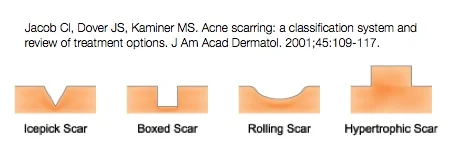
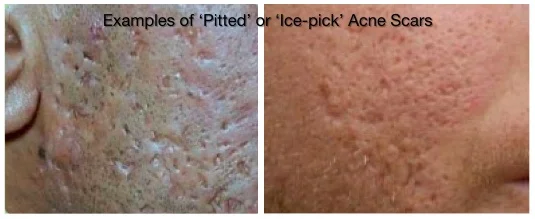
Icepick Scars Icepick scars are among the most common type of acne scar. These are very often narrow, sharp and deep. They give the appearance that the skin has been pierced with a sharp instrument or icepick. They may appear as a deep, open pore; and usually extend into the deep dermis layer.

Ice-pick scars usually develop from a cyst infection or after an inflamed blemish works its way to the skin’s surface. In the process skin tissue becomes destroyed, leaving these column-like scars.

Dermabrasion and Laser Resurfacing can deliver overall improvement and smoothening; but they are often ineffective at improving pitted scars or ice-pick scars as these scars are too deep.

TCA CROSS Acne Scar treatments are especially effective at improving these atrophic pitted ‘icepick’ scars.
scars_ice-pick

TCA CROSS (Chemical Reconstruction of Skin Scars)

This technique is the precise and focused spot application of TCA (trichloracetic acid) into each ‘pitted’ or ‘icepick’ acne scar, avoiding the non-scar areas of normal skin. The resurfacing response that occurs inside the depression stimulates collagen production increases dermal volume, restructuring the dermal elements within the skin, and this eventually causes the scar to rise up (effacement) and close.

In our hands, this technique has been suc­cessful is treating facial acne scars (especially atrophic ice-pick scars) and damaged or open pores. The degree of improvement depends on the number of applications and between 2 to 6 courses of treatment may be required.  Studies demonstrate good improvement after three to six courses in more than 90% of cases.

The technique is safe with few significant complications. Some transient pigmentation and minor scabbing is expected (part of the healing process) and these fully resolves in 2 to 3 weeks. Healing is generally more rapid than conventional full-face medium to deep chemical or laser resurfacing.

It is important to have this procedure performed by a doctor with experience in this technique, as this is very much a procedure that requires expert technique to avoid complications such as burns, prolonged healing, pigmentation etc, that can result from applying too much chemical, or applying it inaccurately. Dr. Jonathan Lee performs this procedure under magnification with specialized instruments.

THE PROCEDURE: How is the TCA CROSS procedure performed?

After cleaning and priming the skin, TCA is applied, very precisely into each ‘pitted’ acne scar with a special applicator. This produces a white ‘frost’ on each acne scar, which disappears in 20 to 30 minutes. A mild redness may persist for several hours after the procedure, and an ointment is applied at regular intervals for the first week to aid in healing. Sun avoidance and use of sun protection is advised, during healing.
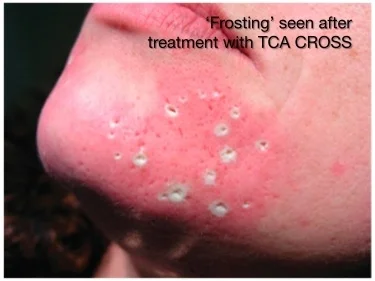
TCA CROSS Treatment with Frosting

ARE TCA CROSS TREATMENTS FOR ACNE SCARS PAINFUL?

The TCA CROSS procedure is relatively painless. There may be slight discomfort, described as a ‘biting’ sensation’ when the chemical is applied, and this lasts only for a few minutes. During the healing phases, there is no discomfort or pain.

WHAT KINDS OF SCARS ARE SUITABLE FOR TCA CROSS TREATMENTS? 

TCA Cross can be used on all skin types (fair skinned or dark skinned, oily or dry skins, younger or older skin types). It is especially useful and effective for treating ‘ice-pick’ or pitted acne scars. TCA CROSS alone can be effective as a single method of treatment for light ice-pick acne scars, or other mild to moderate acne scar types. It results in Scar Effacement, filling and making deep pitted scars shallower. But more often, it is used in combination with other treatments such as laser resurfacing, selective scar excision or subcision, in the treatment of acne scars and improving overall skin texture.

HOW MANY TREATMENTS ARE REQUIRED?

TCA Cross can take one to several treatments depending on the severity of your acne scar case.  Between 2 to 6 treatments may be required.

A 4 to 6 week interval between treatments is required, to allow for skin healing, collagen remodelling and rejuvenation. You are likely to see continued improvements for several months after a treatment.

STUDIES & REPORTS:

An Assessment of the Efficacy and Safety of CROSS Technique with 100% TCA in the Management of Ice Pick Acne Scars. Deepali Bhardwaj and  Niti Khunger. Journal Cutaneous Aesthetic Surgery 2010 May-Aug; 3(2): 93–96.

This Study reported the TCA CROSS technique as a safe, efficacious, cost-effective and minimally invasive technique for the management of ice pick acne scars that are otherwise generally difficult to treat. In this study, using physician’s clinical assessment, photographic evaluation and patient’s feedback, more than 70% improvement was seen in eight out of ten patients evaluated and good results (50 – 70% improvement) were observed in the remaining two patients. No significant side effects were noted.

Focal treatment of acne scars with trichloroacetic acid: chemical reconstruction of skin scars method. Lee JB, Chung WG, Kwahck H, Lee KH. Dermatological Surgery. 2002 Nov;28(11):1017-21; discussion 1021.

One of the original research studies on the TCA CROSS technique, this study demonstrated good satisfaction rates in the 65% TCA and 100% TCA treatment groups, with no cases of significant complication. Patient treatment data indicated good clinical response in 82% of the patient group using 65% TCA, and 94% of patients in the group using 100% TCA. All patients in the 100% TCA group who received five or six courses of treatment showed excellent results.

CROSS technique: chemical reconstruction of skin scars method. Fabbrocini G1, Cacciapuoti S, Fardella N, Pastore F, Monfrecola G. Dermatol Ther. 2008 Nov-Dec;21 Suppl 3:S29-32. doi: 10.1111/j.1529-8019.2008.00239.x.

Histologic study of depressed acne scars treated with serial high-concentration (95%) trichloroacetic acid. Yug A1, Lane JE, Howard MS, Kent DE. Dermatol Surg. 2006 Aug;32(8):985-90; discussion 990.

Evaluation of CROSS technique with 100% TCA in the management of ice pick acne scars in darker skin types. Khunger N1, Bhardwaj D, Khunger M. J Cosmet Dermatol. 2011 Mar;10(1):51-7. doi: 10.1111/j.1473-2165.2010.00526.x.

CONCLUSION: 

TCA CROSS is a safe and very effective single modality for the improvement of deep atrophic pitted ice-pick acne scars with no significant complications. Patient satisfaction is high, the procedure is comfortable and requires little topical anaesthesia. Results are rapid and can been seen within 4 to 6 weeks. The procedure can be used alone, or in combination with other acne scar treatments depending on the type and severity of your acne scars. Many of our acne-scar patients have benefited from the simplicity, comfort and effectiveness of this technique.

[ The Singapore Ministry of Health has mandated that our video links demonstrating the procedure and recovery process be removed. Please contact us directly for more information, brochures, pictures and educational videos of the procedure. ]

To assess if this treatment is suitable for you, and to have an effective treatment plan designed and specifically tailored to your needs; Contact us for an appointment 

Non-Surgical Butt Lift in Singapore
Lift, shape & enhance the buttocks naturally without surgery or implants using non-surgical techniques
What Is a Non-Surgical Butt Lift?

A non-surgical butt lift is a modern aesthetic treatment approach designed to enhance the shape, contour and firmness of the buttocks without surgery, implants or fat transfer. Often described as a non-invasive Brazilian Butt Lift (or non-surgical BBL), it is ideal for patients seeking natural-looking butt enhancements with minimal downtime, lower risk, and more controlled results.

Unlike a traditional Brazilian Butt Lift, which requires liposuction, fat transfer, and general anesthesia, a non-surgical butt lift focuses on refinement rather than dramatic enlargement. Patients can achieve improved projection, symmetry, and overall shape safely and gradually.

Who Is a Suitable Candidate for a Non-Surgical Butt Lift?

A non-surgical butt lift may be suitable for individuals who:

  • Feel their buttocks appear flat or under-projected

  • Have mild to moderate sagging or loss of firmness

  • Are concerned about hip dips or uneven buttock contours

  • Want butt enhancement without surgery

  • Prefer gradual, natural-looking results

  • Are not suitable candidates for a surgical Brazilian Butt Lift

A thorough doctor’s assessment is essential to determine whether a non-invasive butt lift is the right approach for your body and aesthetic goals.

For those interested in learning more about the factors that contribute to an ideal buttock shape and proportion, you can read our detailed article here.

Types of Non-Surgical Butt Lift Treatments

Injectable Collagen Stimulation for Butt Enhancement

Injectable collagen stimulators, such as poly-L-lactic acid (PLLA), gradually timulate the body to produce new collagen, strengthening the underlying buttock structure. This improves projection, contour, and tissue firmness over time.

Unlike traditional fillers that only add temporary volume, injectable collagen stimulators create a natural, progressive lift, making them ideal for patients seeking refined butt enhancements rather than dramatic enlargement.

Benefits:

  • Gradual, natural-looking lift
  • Improved buttock shape and projection
  • Firmer, smoother skin texture

Butt Fillers for Shape & Symmetry contour

Butt fillers are used to refine shape, smooth contour irregularities, and correct mild asymmetry. When administered carefully by a doctor, fillers can improve the overall silhouette of the buttocks in a way that complements the hips and waist.

These treatments are particularly suited for patients who want targeted enhancement and smooth transitions between anatomical areas, achieving proportions that look natural and aesthetically pleasing.

Benefits:

  • Smooths contour irregularities
  • Corrects mild asymmetry
  • Refines overall silhouette

Energy-based Butt Lift for Gluteal muscle tone

Energy-based treatments, such as truSculpt Flex, help tone glute muscles by focusing on muscle conditioning to supporting overall contour and firmness of the buttocks without surgery.

While they do not add volume, it relies on targeted electrical muscle stimulation to activate the glute muscles, helping to enhance the appearance of lift, firmness and shape by supporting soft‑tissue structure.

Benefits:

  • Improves skin firmness and texture
  • Subtly enhances buttock contour
  • Minimal downtime and a non‑invasive approach
Frequently Asked Questions
Are non‑surgical butt lifts safe?

When performed by a qualified, experienced medical professional, non‑surgical butt lift treatments are considered safe and well‑tolerated. Key points that contribute to safety include:

  • Doctor‑led assessment and customized treatment planning

  • Use of medically approved injectables and energy‑based devices

  • Careful technique to minimise risk

  • Clear aftercare guidance

Non‑surgical options avoid the risks associated with general anesthesia, fat transfer and surgical incisions. That said, every medical treatment carries some degree of risk, which is why informed consent, proper evaluation, and expert execution are essential.

Yes, non‑surgical butt lift treatments do work for many patients when performed by qualified doctors. These options are designed to improve buttock shape, contour, projection, and skin quality without surgery:

  • Injectable collagen stimulators gradually strengthen the underlying tissue structure and build new collagen over time, leading to a natural‑looking lift and improved firmness

  • Butt fillers improve targeted volume and smooth contour irregularities

  • Energy‑based treatments like activate glute muscles to improve tone and definition, while supporting overall contour

While results may vary by treatment type, individual anatomy, and treatment plan, many patients experience noticeable improvement in shape and firmness without surgery. It’s important to set realistic expectations, as non‑surgical methods produce gradual, subtle enhancement rather than dramatic volume increases.

One of the major benefits of a non‑surgical butt lift is minimal downtime. Most patients can return to everyday activities immediately or within a day. However:

  • Injectable treatments may cause mild swelling, redness, or bruising, typically resolving within a few days.

  • Energy‑based procedures can leave the skin feeling warm or slightly tender, usually subsiding quickly.

Because these treatments avoid incisions and general anesthesia, they do not require the long recovery associated with surgical procedures.

Non-surgical butt lifts are designed for refinement, subtle lift, and contour enhancement, rather than dramatic volume increases.

While they cannot replicate the major augmentation achieved with a surgical Brazilian Butt Lift (BBL), they offer a safer, less invasive alternative for patients who want to improve projection, firmness, and shape without undergoing surgery.

Non-surgical treatments also allow for gradual, controlled improvements, giving patients a more natural, balanced result that complements their overall body proportions.

Results depend on the type of non‑surgical treatment used:

  • Butt fillers often show immediate contour improvement after the procedure.

  • Injectable collagen stimulators work over time — most patients see progressive enhancement over several weeks to months, as new collagen develops.

  • Energy‑based treatments provide subtle improvements that accumulate over a series of sessions.

Because non‑surgical butt lift treatments focus on natural tissue changes rather than brute volume addition, results tend to appear gradually.