

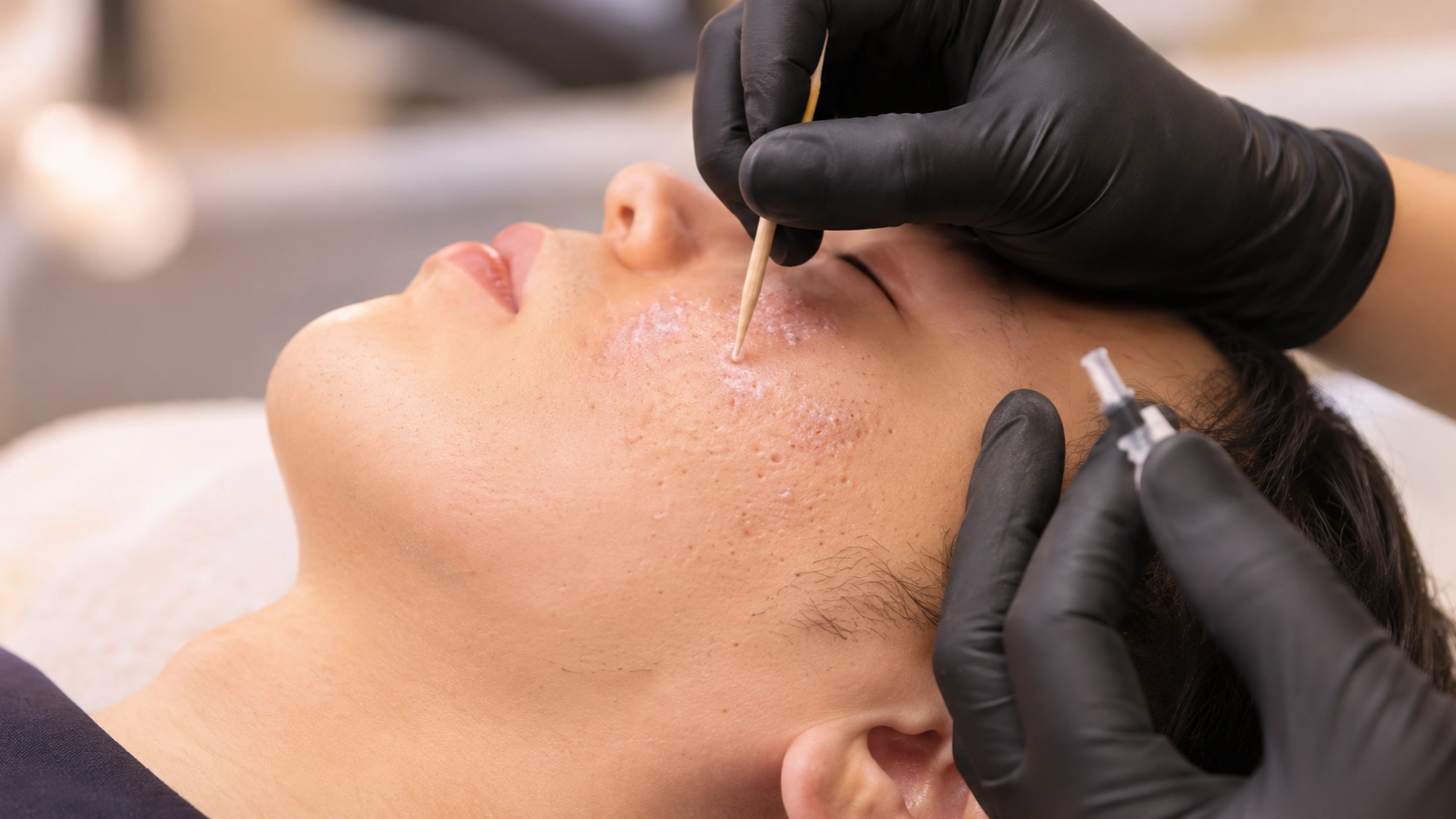
For most people, the hardest part of TCA Cross isn’t the treatment. It’s the week after. You’re told the scars will look shallower in time. Then you wake up the next morning to small dark dots exactly where the deepest pits were, and they’re more noticeable than the scars ever were. A few days later the dots fall away, leaving pink marks behind, and it’s tempting to start judging the result.
That’s usually too early. Healing after TCA Cross isn’t one event. It happens in stages, and each stage shows you something different. Knowing what’s normal at each point, and what isn’t, makes the waiting much easier. It also helps you plan work, social events and the next session realistically.
The short answer
What is healing like after TCA Cross, and how long is the downtime?
Healing after TCA Cross usually follows four stages. Each treated scar turns white (frosting) for minutes to hours. Small dark scabs form within a day or two and usually fall off within about a week. The new skin underneath often stays pink for several weeks. Meanwhile collagen remodelling continues for months. Most people return to work the next day, but early improvement is usually judged from around four to six weeks, and the full effect over several months.
Why TCA Cross heals differently from a chemical peel
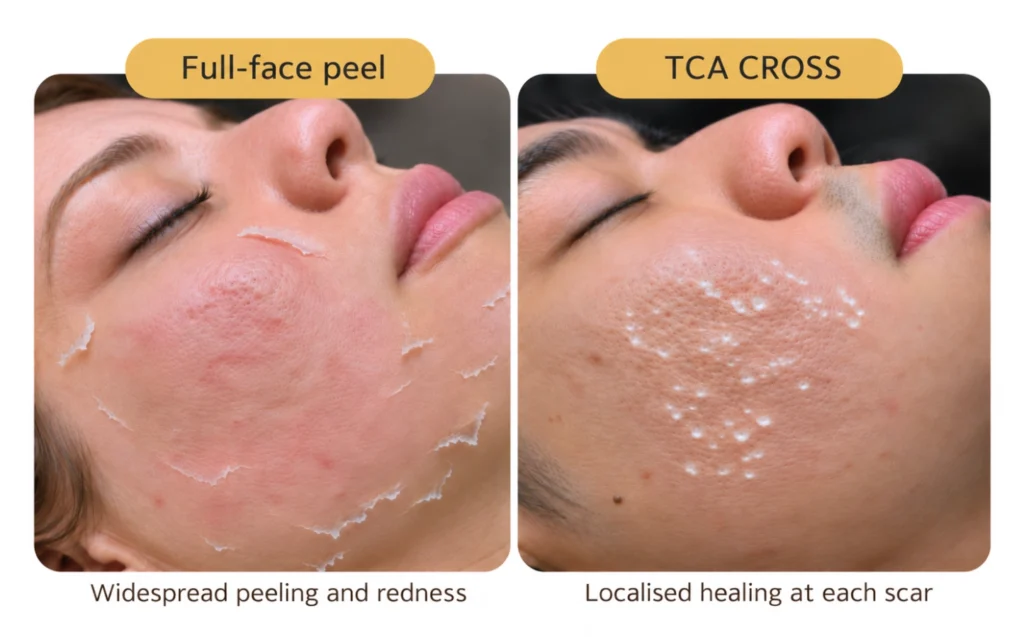
A chemical peel treats the whole surface of the skin. Healing happens everywhere at once, so the downtime is redness and peeling across the face. The improvement is spread out too, which is why these treatments smooth overall texture but often can’t reach the bottom of deep, narrow pits.
TCA Cross works the other way round. Instead of treating the face, our doctor treats the scars, one at a time. A tiny amount of concentrated trichloroacetic acid (TCA) is placed into the base of each deep, narrow scar. These are usually ice pick scars, and sometimes narrow boxcar scars. The skin in between is left alone.
Inside each pit, the acid creates a small, controlled injury, and the skin’s repair response rebuilds collagen from the bottom up, gradually lifting the floor of the scar.
That precision shapes the recovery. There’s no peeling and no all-over redness. Instead, there’s a scatter of small healing points, one on every treated scar. You can read more about how TCA Cross targets individual ice pick scars, and which scars it suits.
The four stages at a glance
| Stage | Typical timing | What you’ll usually see | Usually normal | Worth contacting the clinic |
|---|---|---|---|---|
| 1. Frost | Seconds after application; fades over minutes to a few hours | White spots on each treated scar, mild stinging, slight puffiness | Stinging that settles quickly; redness around the spots for the rest of the day | Severe or increasing pain; white areas well beyond the scars |
| 2. Crust | Forms within a day or two; usually falls off within about a week | Small brown or dark scabs sitting in each scar | Scars looking more obvious for a few days; mild itch | Crusts spreading wider than the scars; an open, weeping area still unhealed after about 10 days; pus, warmth or clustered blisters |
| 3. Pink | From when the crusts fall off, often lasting several weeks | Pink or red spots where the crusts were; sometimes a brown tinge | Pinkness that fades gradually; a light brown tinge that fades over weeks | Brown marks that keep darkening; pale white spots that don’t repigment |
| 4. Remodelling | Weeks to months | Scars gradually looking shallower, with softer edges | Change that is slow and easiest to see in photos taken months apart | A scar that looks wider or deeper once fully healed |
Timings vary with the TCA concentration used, the number and depth of scars treated, your skin type and how your skin heals. Always follow our doctor’s aftercare instructions.
Stage 1: Frost (the first few hours)
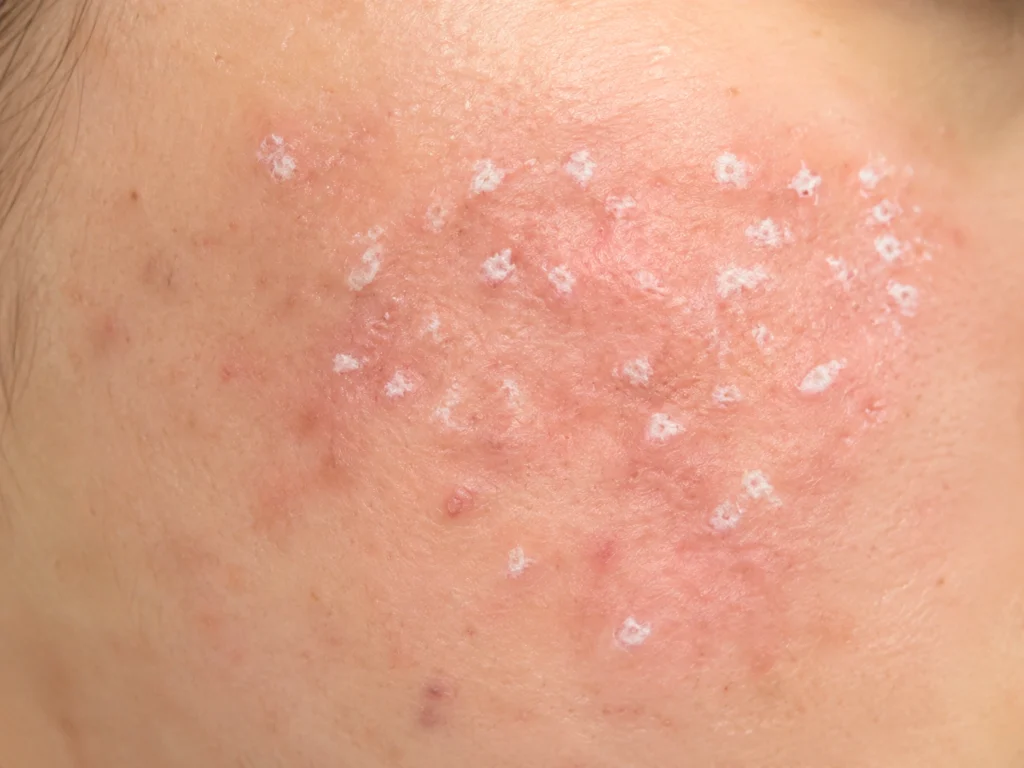
Within seconds of the acid being applied, the base of each scar turns white. This “frost” is the endpoint our doctor looks for. It shows the acid has reached the intended depth, which is why each scar is treated individually and with care.¹ Most patients feel a brief, sharp sting during application, which settles quickly.
The frost fades over the following hours. In one small study using 100% TCA, frosting, redness and swelling had eased within four to six hours.² The treated spots may stay slightly red and raised for the rest of the day, but most patients can generally return to their usual activities.
Stage 2: Crust (roughly the first week)
By the next day, each treated scar usually darkens into a small brown or dark crust. For a few days, the scars can look more noticeable than they did before treatment. This is expected, and it is often the stage patients find most surprising.
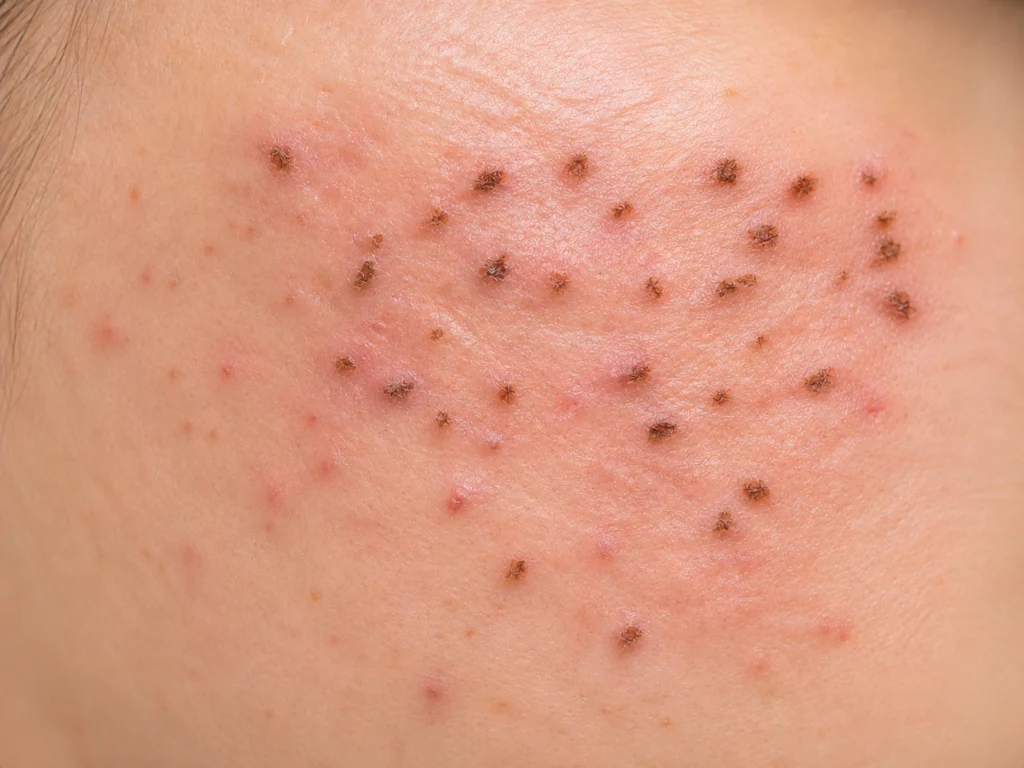
The crust is not a setback. It forms a protective layer while the scar heals underneath. In the same study, crusts appeared the day after treatment and had settled within three to four days in most patients, although one patient’s lasted seven days.² Across the wider research, mild crusting is described as “nearly universal” and usually resolves without problems.¹ Most crusts fall off on their own within about a week.
It is important to leave the crusts alone. Removing them early exposes skin that is not yet ready, which can prolong the redness and increase the risk of dark marks.
What it tells you: healing is progressing as expected. Crusts that stay roughly the size of the original scars are a good sign. If a crust spreads noticeably wider, let us know so our doctor can review it.
Stage 3: Pink (the following weeks)
Once the crusts fall off, the new skin underneath is pink. This is usually the longest visible stage. In one small series, the redness faded over three to eight weeks.¹ The pink spots are flat, fade gradually, and can usually be covered with makeup.
What it tells you: the surface has healed, and collagen remodelling is under way beneath it.
Stage 4: Remodelling (weeks to months)
This is the stage that improves the scars. Beneath the surface, new collagen forms inside each treated scar, gradually raising its base and softening its edges. Early improvement is often visible from around four to six weeks. Scars continue to soften over the next two to three months, and remodelling can continue for up to around six months.
Because the change is gradual, it can be hard to see from day to day. Photos taken in the same lighting and at the same angle, before treatment and a few months afterwards, give a more accurate comparison.
What it tells you: the actual result of treatment, which is best judged once the pinkness has settled. A scar that still looks red at three weeks is still healing.
Looking after your skin while it heals
Good aftercare helps protect your result. Our doctor will give you instructions based on the number of scars treated and your skin, but most aftercare follows a few principles:
- Cleanse gently. Use a mild cleanser, and avoid scrubs or exfoliating tools on the treated areas.
- Let the crusts fall off naturally. Apply any ointment provided as instructed.
- Pause strong active ingredients. Retinoids, AHAs and BHAs are usually stopped for at least a week, or until our doctor advises otherwise.
- Use sunscreen daily. Apply broad-spectrum sunscreen every day and reapply it when outdoors. This is the most important step in reducing the risk of dark marks.
- Delay makeup briefly. Avoid makeup for the first day or two, and keep it off the crusts. Once they have shed, makeup can be used to cover any pinkness.
- Avoid heat and heavy sweating. While the crusts are present, avoid saunas, swimming pools and intense workouts, which can soften the crusts too early.
Before treatment, let us know if you have a history of cold sores, keloid scarring, recent or current isotretinoin use, or a tendency to develop dark marks after spots or injuries. These can affect the timing, the preparation, or whether TCA Cross is suitable for you.
Why recovery is predictable but results vary
Recovery follows a similar pattern for most patients. Results vary more, because they depend largely on the type and depth of the scars being treated.
TCA Cross is designed for narrow, deep scars. Rolling scars, which are tethered by bands of tissue beneath the skin, and wide, shallow scars usually respond better to other treatments. Many patients have a mix of acne scar types, so TCA Cross is often one part of a broader treatment plan. For example, it may be used after resurfacing has improved the surrounding skin but left the deepest pits behind.
Considering TCA Cross, or unsure about your acne scars?
If you’re considering TCA Cross and want to know whether your scars are suitable, how your skin is likely to heal and how many sessions might be involved, an assessment is the best place to start.
If you’ve already been treated and something doesn’t look right, a review can help too.
Frequently asked questions
How much downtime is there after TCA Cross?
Most people return to work or study the next day. TCA Cross treats only the individual scars, not the whole face, so there’s no peeling or all-over redness. What you will have is a small dark crust on each treated scar, usually for about a week, followed by pink spots that fade over several weeks.
Whether that counts as downtime depends on how many scars were treated and how comfortable you are being seen with them. Makeup usually covers the pink stage well, but not the crusts. If you have an important event, interview or photos, it’s sensible to leave about two weeks after treatment.
Can I see photos of what TCA Cross healing looks like?
It’s an understandable request, especially before committing to a treatment with visible healing. In Singapore, clinics aren’t allowed to feature before-and-after or post-treatment photographs in advertising, including on their websites.
Our doctor can show you clinical photographs during your consultation and explain what you’re looking at, including how healing can vary between people. That conversation is also the best way to find out how your own scars, skin tone and healing history are likely to affect your recovery.
I have brown marks after TCA Cross. Will they go away?
Brown marks after the crusts fall off are usually post-inflammatory hyperpigmentation, a temporary darkening of the skin after inflammation. It’s the most frequently reported side effect of TCA Cross and is more likely in medium and darker skin tones, which includes many people in Singapore. In most published cases it was temporary and faded over weeks, sometimes months.
Daily sunscreen is the most important thing you can do. Avoid strong lightening products or harsh exfoliants on your own, as these can irritate healing skin. Instead, let our doctor see the marks. Treatment, if needed, is usually manageable, and the information helps when planning your next session.
Why do my scars look worse a few days after TCA Cross?
This is one of the most common worries, and it’s usually a normal part of healing. In the first week, each treated scar fills with a small dark crust, so the scars can look more noticeable than they did before. After the crusts fall off, the new skin is pink, which can make the scars stand out for a few more weeks.
Neither stage reflects the final result. The collagen remodelling that makes scars shallower happens more slowly underneath, over weeks to months. It’s best to judge the outcome once the pinkness has settled, ideally by comparing photos taken in the same light. If a crust spreads well beyond the scar, or a scar looks wider once fully healed, show our doctor.
When can I exercise, swim or wear makeup after TCA Cross?
These depend on our doctor’s instructions, but there are some common principles. Makeup is usually avoided for the first day or two and kept off the crusts themselves. Once they’ve shed, it can be used to cover pinkness.
Light activity is usually fine. While the crusts are present, it’s sensible to avoid very sweaty workouts, saunas and swimming pools, because heat, sweat and chlorinated water can soften crusts early and irritate the skin. Strong skincare actives such as retinoids, AHAs and BHAs are usually paused for at least a week. Sunscreen should continue throughout.
How long do the scabs last after TCA Cross, and what if I pick them?
The crusts usually form within a day or two and fall off on their own within about a week, though this varies with the concentration used and your skin. Try hard not to pick, scratch or scrub them, even when they’re loose at the edges. Removing a crust early exposes skin that isn’t ready. That can prolong the redness, increase the chance of dark marks, and potentially affect how the scar heals.
If you’ve accidentally knocked one off, keep the area clean, apply the ointment you were given and protect it from the sun. If a raw area hasn’t closed after about ten days, contact the clinic.
When will I know if TCA Cross has worked, and when is the next session?
Early improvement is often noticeable from around four to six weeks, once the pinkness has started to fade. Scars may keep softening for several months, as collagen continues to remodel for up to around six months.
Because ice pick scars usually need more than one session, treatments are commonly spaced about four to six weeks apart, sometimes longer for darker skin or higher acid concentrations. Each review is a chance to assess how your skin healed and how the scars have responded, and to adjust the plan. The fairest judgement of the overall result usually comes a few months after the last session, rather than after the first.
Medical References
- Stratman S, He H. The use of chemical reconstruction of skin scars (CROSS) method with trichloroacetic acid (TCA) for atrophic scars: a comprehensive review on application techniques, adjunct therapies, and complications. Journal of Clinical and Aesthetic Dermatology. 2026;19(6):52–67.
- Bhardwaj D, Khunger N. An assessment of the efficacy and safety of CROSS technique with 100% TCA in the management of ice pick acne scars. Journal of Cutaneous and Aesthetic Surgery. 2010;3(2):93–96. View published study
About This Article
Medically reviewed by Dr. Jonathan Lee, Aesthetic Physician & Consultant Surgeon · Last reviewed November 2026
This article is for general education and does not replace a doctor’s consultation. Healing times after TCA Cross vary with the scars treated, the technique and concentration used, skin type and individual healing.