

Dark Eye Circles Treatment in Singapore
Dark circles may look similar, but the treatment can be very different depending on what is creating the darkness beneath your eyes
Introduction
Understanding Dark Eye Circles

Dark eye circles can look like a single concern, but the darkness beneath the eyes may come from very different things.
For some people, pigmentation is the main contributor. For others, visible vessels, thin skin, under-eye hollowness, eye bags or the way light falls across the lower eyelid may play a greater role. Many people have more than one factor at the same time.
This is why choosing a dark eye circle treatment based only on how the area looks can be limiting. A treatment that improves pigmentation will not correct a structural hollow, while adding volume will not remove pigment or vascular colour.
The aim is not simply to make the area look brighter. It is to treat the factors that are actually making it look dark.
Causes
What Is Actually Causing Your Dark Eye Circles?
Dark eye circles are often a combination of several changes happening at different layers around the eye.
At The Aesthetic Studio Clinic, we use a 5-Layer Under-Eye Assessment that looks beyond the surface to understand what is actually creating the dark appearance.
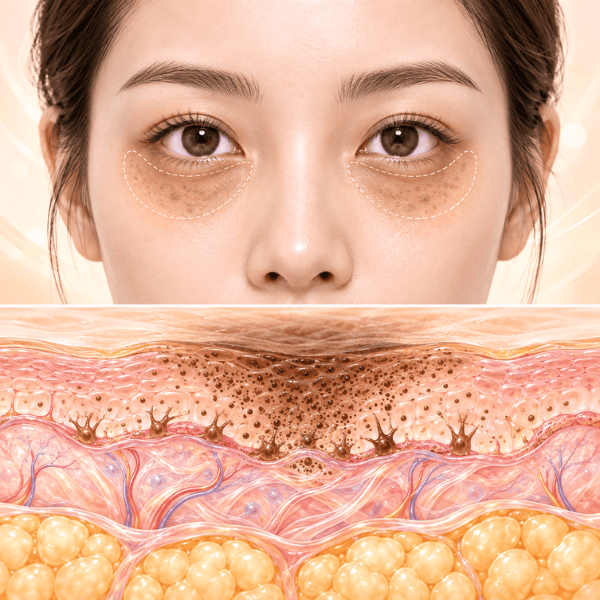
01. Pigment
Is the darkness coming from pigment?
We assess the colour, distribution and pattern of pigmentation, together with skin type, irritation history and previous treatment response.
What may be contributing
Pigment-related dark circles may be influenced by increased melanin, sun exposure, post-inflammatory pigmentation or repeated rubbing and irritation around the eyes.
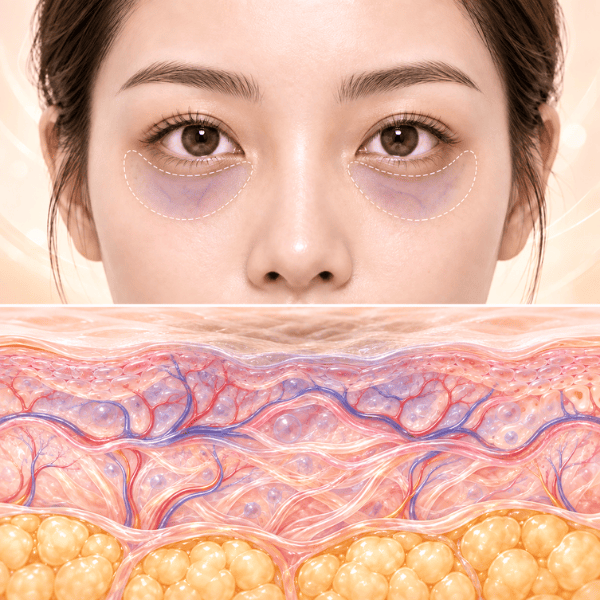
02. Vascularity
Are vessels contributing to the darkness?
We assess blue, purple or reddish tones, visible vessels, skin translucency and how the colour changes under different lighting.
What may be contributing
Vascular-looking dark circles may occur when superficial vessels, venous colour or underlying muscle become more visible through thin lower-eyelid skin.
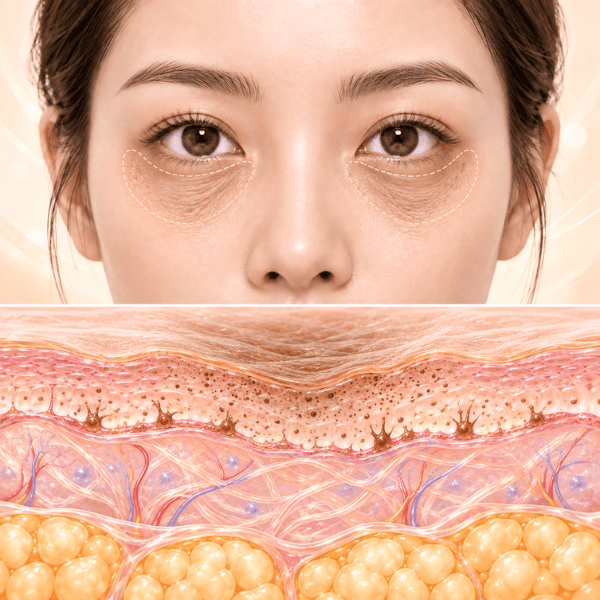
03. Skin Quality
Is thin skin making the area look darker?
We assess skin thickness, hydration, texture, fine lines and elasticity, as well as how visible the underlying structures appear.
What may be contributing
Ageing, sun exposure, genetics and inflammation can affect under-eye skin quality, making vessels and deeper structures more visible.
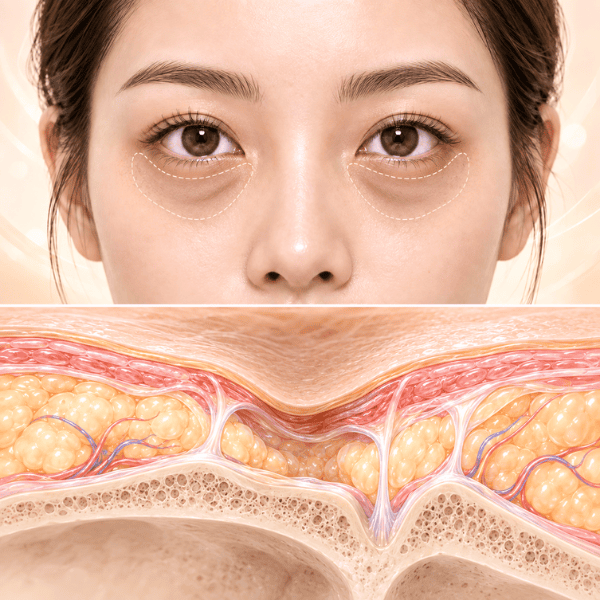
04. Structure & Volume
Is the darkness actually coming from shadow?
We assess tear-trough depth, cheek support, orbital contour and how the under-eye changes with lighting and facial position.
What may be contributing
Genetics, facial anatomy and age-related changes in bone, fat and soft-tissue support can create hollowness and shadow beneath the eye.
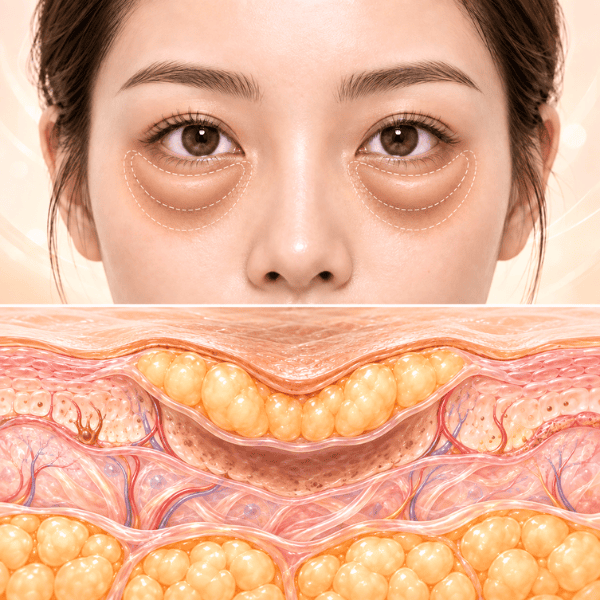
05. Eye Bags & Puffiness
Are eye bags creating the dark appearance?
We assess lower-eyelid bags, puffiness, skin laxity, fluid tendency and the contour between the eyelid and upper cheek.
What may be contributing
Fat prominence, fluid retention, laxity or changes in lower-eyelid anatomy can create a bulge and shadow that makes the under-eye look darker.
Treatment
Dark Eye Circle Treatment Options in Singapore
Dark eye circle treatment should be matched to what is actually creating the dark appearance, rather than starting with a particular laser, injectable or device.
At The Aesthetic Studio Clinic, the treatment plan is built around three questions:
- What is the main treatment target?
- Which treatment has the clearest role for that target?
- Does anything else need to be addressed before, after or instead?
| If the main issue is… | Treatment may include | Treatment focus |
|---|---|---|
|
Under-eye pigmentation |
Medical skincare, chemical peels, pigment-directed laser or light treatment |
Reduce brown or grey-brown pigment contributing to dark eye circles |
|
Vascular dark circles |
Vascular or light-based treatment, together with skin-quality treatment where appropriate |
Reduce visible vascular colour and vessel show-through beneath thin under-eye skin |
|
Thin or crepey under-eye skin |
Skin-quality injectables, regenerative treatments, resurfacing or energy-based treatment |
Improve skin quality, texture, elasticity and support around the under-eye |
|
Tear-trough hollowness |
Hyaluronic acid filler or treatment of adjacent cheek support, depending on the anatomy |
Reduce the shadow created by under-eye hollowness and loss of structural support |
|
Eye bags or puffiness |
Improve the contour or skin quality contributing to shadow beneath the lower eyelid |
Skin-quality or structural treatment where appropriate; referral for surgical assessment when significant fat prolapse or laxity is present |
If Treatment Hasn’t Worked
Why Dark Eye Circle Treatment May Not Work
Dark eye circle treatment may give limited improvement when the treatment does not fully match what is creating the dark appearance.
Sometimes, one part improves while another remains. Pigmentation may lighten while a tear-trough shadow is still visible. Skin quality may improve while eye-bag anatomy continues to create darkness. In mixed dark circles, this can make the overall result feel incomplete.
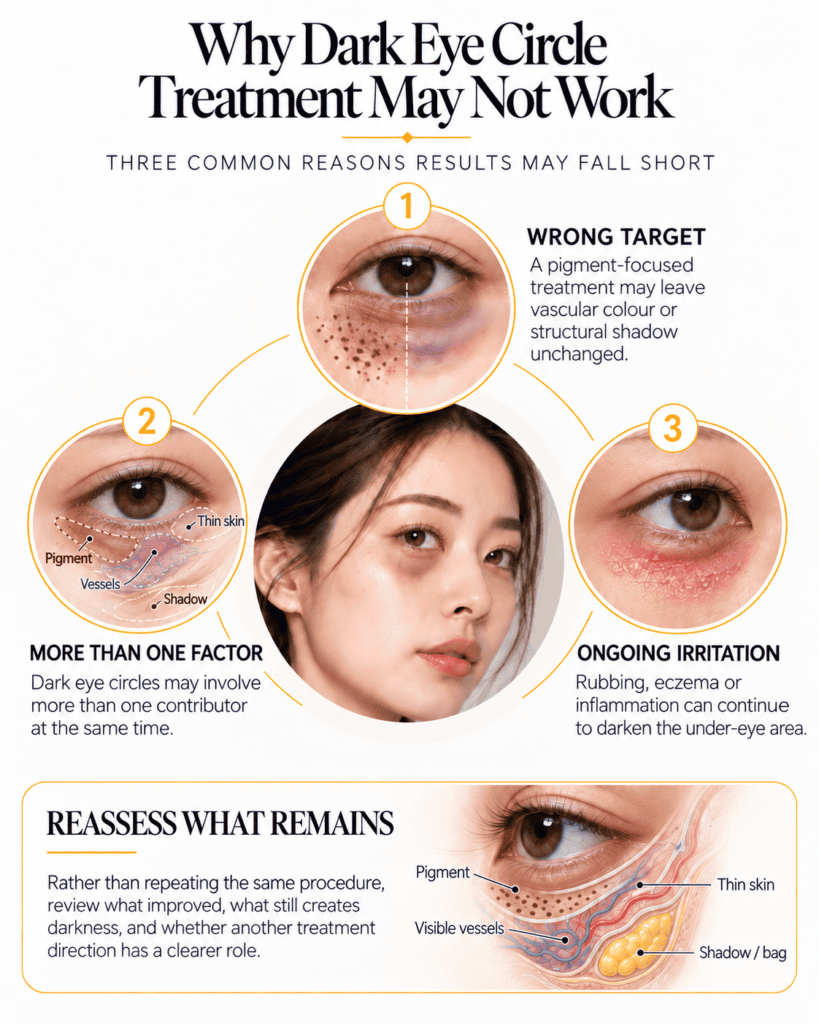
The treatment targeted the wrong problem
A treatment aimed at pigmentation will have limited effect if the darkness is mainly caused by vascular show-through, a tear-trough hollow or eye-bag shadow. The treatment needs to match the factor creating the dark appearance.
More than one factor was contributing
Dark eye circles are often mixed. Improving one component may reveal another more clearly, which can make the overall result seem incomplete even when part of the under-eye has improved.
Ongoing irritation is continuing to darken the area
Eye rubbing, eczema, dermatitis or recurrent inflammation can continue to drive pigmentation. Treating the colour without addressing an ongoing trigger may therefore produce limited or temporary improvement.
For patients who still have dark eye circles after treatment, reassessment may be more useful than simply repeating the same procedure.
FAQ
Frequently Asked Questions About Dark Eye Circles
What causes dark eye circles?
Dark eye circles can be caused by pigmentation, visible blood vessels, thin skin, structural hollowing, eye bags, inflammation or several of these factors together.
Brown or grey-brown darkness may have a stronger pigment component, while blue or purple tones may reflect vascular show-through beneath thin skin. In other people, the skin itself may be relatively normal in colour but appear dark because a tear trough or eye bag creates shadow.
This is why “dark eye circles” describes an appearance rather than one diagnosis. Identifying the dominant contributor is important because treatments directed at pigmentation, skin quality and facial structure perform different roles.
Do dark eye circles require surgery?
Most people with dark eye circles do not automatically require surgery.
However, when prominent eye bags, significant fat prolapse or lower-eyelid laxity are major contributors, non-surgical skin treatments may have limited ability to change the underlying anatomy.
In these cases, surgical assessment or referral may sometimes be more appropriate than repeatedly performing treatments that cannot correct the structural problem.
Can eye creams remove dark eye circles?
Eye creams can improve hydration, barrier support and selected surface concerns, but they are unlikely to remove every type of dark eye circle.
If pigmentation is mild or the skin is dry and crepey, appropriate skincare may make the under-eye look better. However, an eye cream cannot replace structural support, remove a prominent eye bag or completely correct a deep tear-trough shadow.
This is why some people use eye creams consistently without seeing much change in the darkness: the main cause may not be something topical skincare can correct.
Are dark eye circles caused by lack of sleep?
Not always. Lack of sleep can make dark eye circles look more noticeable, but it is rarely the only possible cause.
Darkness beneath the eyes can also come from pigmentation, visible blood vessels, thin under-eye skin, tear-trough hollowing, eye bags or a combination of several factors. This is why some people continue to have dark circles despite sleeping well.
Poor sleep may temporarily make the eyes look more tired or puffy, but improving sleep will not correct pigmentation, a structural tear trough or a true eye bag. If dark eye circles persist despite adequate rest, it may be useful to assess what is actually creating the dark appearance.
Can dark eye circles be treated without filler?
Yes. Many dark eye circles can be treated without filler when structural hollowing is not the main problem.
Non-filler treatment may be appropriate when pigmentation, visible vascularity, inflammation, thin skin, skin quality, texture or selected laxity is contributing to the appearance.
However, “without filler” is not itself a treatment plan. If the darkness is largely caused by a deep tear-trough hollow, improving pigment or skin quality may make the under-eye look better without completely removing the structural shadow.
Treatment should therefore be chosen according to what is contributing rather than according to whether a particular procedure is preferred or avoided.
What is the best treatment for dark eye circles?
There is no single best treatment for every type of dark eye circle.
The most appropriate treatment depends on what is causing the dark appearance. Pigment-related dark circles may be considered for pigment-directed skincare, peels or selected laser or light treatments. Vascular colour requires a different approach. Thin or crepey skin may benefit from skin-quality treatment, while selected tear-trough hollows may require structural assessment.
A true eye bag is different again.
The useful question is therefore not simply, “What is the best dark eye circle treatment?” but “What is creating my dark circles, and which treatment has a logical role for that particular problem?”
Are “panda eyes” the same as dark eye circles?
“Panda eyes” is an informal term commonly used to describe darkness around or beneath the eyes, but it does not describe the underlying cause.
Someone using the term “panda eyes” may have pigmentation, visible vessels, thin skin, tear-trough shadow, eye bags or several contributing factors.
The term is therefore useful for describing appearance but not for choosing treatment.
Why do I still have dark eye circles even though I sleep enough?
Because sleep is only one factor that may influence how tired the under-eye looks.
Persistent dark eye circles may instead be related to pigmentation, visible blood vessels, thin skin, inherited anatomy, tear-trough hollowing, eye bags or a combination of these.
For example, someone with an anatomical tear trough may continue to have a shadow regardless of how much sleep they get. Similarly, pigmentation will not disappear simply because sleep improves.
If dark circles remain despite adequate sleep, the next step is usually to determine whether the darkness is mainly colour, shadow, skin quality or lower-eyelid anatomy.