


You did what you were supposed to do. Your acne scars bothered you, so you found a clinic, paid for treatment and sat through the redness and peeling. Perhaps you went back for a second session, or a third.
And yet, in the bathroom mirror, especially under that overhead light, the scars are still there.
Now you are facing a harder question than the one you started with. Do you do more laser? Try something else? Or accept that acne scars simply do not improve?
Before answering any of those, it is worth answering a different one first.
The short answer
Why didn’t laser improve my acne scars?
Acne scars can remain after laser because “acne scarring” is often several different structural problems at once. Fractional laser resurfaces the skin and stimulates collagen, which can help surface texture and shallower scars. But it does not release scars that are tethered from below, and it may not fully reach narrow scars that run deep. Those scars may respond better to targeted approaches such as subcision or TCA CROSS, and scars caused by lost volume may need that volume restored, often alongside laser.
That explains many disappointing results. It is not the whole story for every patient, though, and that is exactly the point of this article.
Before changing treatments, change the question
When laser has not delivered the result you hoped for, the natural next search is what to try instead.
It is an understandable instinct. But it skips a step. The more useful question is: why did this result fall short?
The honest answer differs from person to person:
The course may never have been completed.
New breakouts may have kept adding scars.
The scars that bother you most may not be the kind resurfacing is designed to change.
The laser settings or treatment depth may not have been well matched to the scar type or your skin.
Sometimes there was very little visible improvement at all.
Each of those possibilities leads somewhere different. Choosing the next treatment without knowing which one applies to you is, in effect, guessing again.
To be clear, laser is not the villain here. Fractional lasers, including fractional CO2 laser, are among the most studied treatments for depressed acne scars, and they are part of how we treat scarring ourselves.
The question is never whether laser works in general. It is what laser was able to change in your skin, and what it was not.
Does laser work for all types of acne scars?
Not equally.
Laser tends to help most where scarring sits within reach of resurfacing: surface texture and shallower depressions. It tends to help less where a scar is held down from beneath, or extends deep through a narrow opening.
To see why, it helps to know what a fractional laser actually does. It creates thousands of microscopic treatment columns in the skin. As they heal, the surface renews and new collagen forms in the dermis.
In other words, it treats what it can reach, in the way its mechanism allows.
But not every acne scar is built the same way. A scar can look like a surface problem without being only a surface problem.
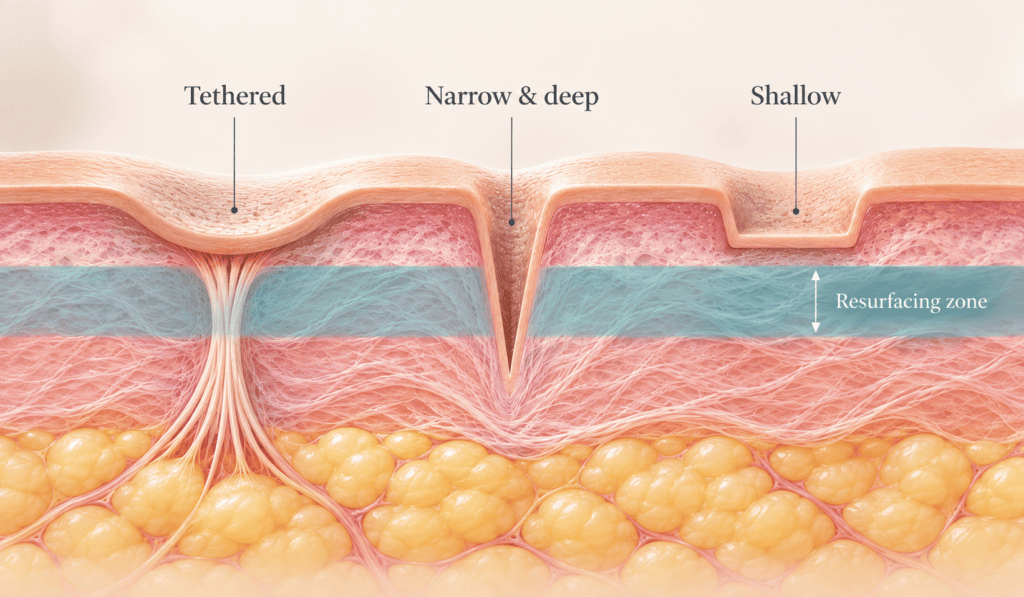
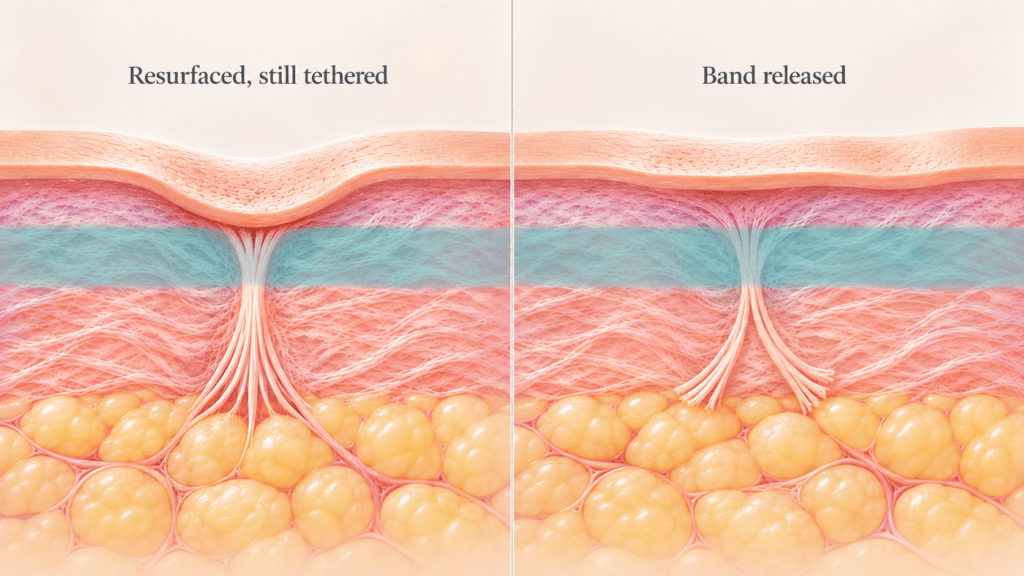
Take a broad, rolling depression, the kind that makes skin look uneven under overhead light. From the outside, it reads as a dip in texture. Underneath, part of what you are seeing may be caused by fibrous bands of scar tissue tethering the skin to deeper tissue.
Laser can refine the surface over that dip. It does not cut the band that pulls it down. Subcision, which releases those bands from beneath, exists for precisely that reason.
Now take a tiny ice-pick scar. It looks less dramatic, often under 2 mm across, but it can extend far deeper than its opening suggests.
Broad resurfacing can smooth the skin around it without fully remodelling the bottom of the pit. In studies of fractional laser, ice-pick scars have tended to respond the least of the three main scar types.¹ That is why these scars sometimes look more obvious after treatment, not less.
For deep, narrow scars like these, TCA CROSS may be considered. Rather than treating the whole surface, a high-strength acid is placed precisely into each scar to stimulate collagen within it.
A shallow boxcar scar, with its crisper edges, may behave differently again. It often responds reasonably well to resurfacing, unless it runs deeper than it looks.
You do not need to memorise scar names. The important idea is this: what looks like “acne scarring” from the outside may be several different structural problems underneath, and a single mechanism rarely addresses all of them.
Why the same laser can give one face several different results
Very few people have only one type of scar.
Acne scars form breakout by breakout, and each heals in its own way. The same cheek can hold tethered scars, deep narrow ones and shallow ones side by side.
That is why results so often feel contradictory. Your skin may look smoother overall while the scars you notice most look exactly the same. Both observations can be true at once.
Those remaining scars are worth paying attention to. The scars that remain can tell you more than the scars that improved. In many cases, they are a record of the features resurfacing did not reach.
Key takeaway
Acne scars that remain after laser do not automatically mean the treatment was wrong, or that nothing more can be done. They often point to specific scar features that work differently from the ones laser addresses, and identifying those features is the starting point for any sensible next step.
Why else might the result have fallen short?
Scar structure is the most common explanation. But it is rarely the only thing worth checking.
The course may not have been completed. Acne scar treatment is usually planned as a series, because each session adds a partial change. Research in Asian skin has associated a course of around three sessions with better outcomes than one or two.²
It may have been judged too early. Collagen remodelling continues for months after each session. In a study of fractional CO2 laser in Asian skin, improvement kept building for up to six months after the final treatment.³
Colour may be clouding the picture. Temporary redness or darkening after laser is common in Asian skin, and while it lasts it can make scars look more prominent. Sometimes part of what looks like persistent scarring is post-inflammatory hyperpigmentation, which behaves quite differently from structural scarring and can linger longer with Singapore’s year-round sun exposure.
New acne may have kept adding scars. If breakouts continued during treatment, fresh scars may have formed while older ones were being treated. That is why getting active acne under control is usually part of the plan.
None of this means earlier treatment was done wrongly. And none of it means your disappointment is not real. It means the reason behind it is worth identifying.
Worth knowing
If you completed a full course, waited three months or more, and specific scars still look unchanged, timing is unlikely to be the reason. Scar structure is the more likely explanation, and that is what a reassessment should look at.
Should you repeat the same laser treatment?
Sometimes, but not by default.
If the course was cut short, or shallow scars were still improving gradually, further sessions may be entirely reasonable.
But suppose you completed a course, waited several months, and specific scars still look unchanged. In that case, repeating the same treatment may not address what is left.
More laser is not automatically the same as addressing what remains. Another round of resurfacing refines the surface further. It does not release a tether or reach the base of a deep, narrow scar.
Why not simply turn the laser up? Higher energy can mean more change per session, but it also increases downtime and the risk of post-inflammatory hyperpigmentation, which is a particular concern in Asian skin. That is why settings are often kept deliberately conservative, and why stronger settings still cannot release a tethered scar or restore lost volume.
The reverse is also true. Switching to a different device is not automatically the answer either. A new machine chosen without understanding why the last one fell short is still a guess.
What should you do if acne scar laser didn’t work?
Start by finding out why.
A proper reassessment maps the scars that remain, reviews what was previously done and how your skin responded, and checks for tethering, depth, pigmentation and active acne. That gives you a real basis for deciding whether further treatment is worthwhile, and if so, what kind.
Where the remaining scars are tethered, deep and narrow, or caused by lost volume, that often points to a different mechanism rather than more of the same.
- Subcision for tethered, rolling scars. A fine needle is passed beneath the scar to release the fibrous bands pulling the skin down. It is typically considered for broad, rolling scars that soften when the skin is gently stretched, because resurfacing alone does not release tethering.
- TCA CROSS for deep, narrow scars. A high-strength trichloroacetic acid is applied precisely into individual ice-pick and some narrow boxcar scars, stimulating collagen within each scar rather than across the whole skin surface. Treated spots typically crust and peel over about a week.
- Volume replacement for scars caused by lost tissue. Some broad depressions are partly caused by lost volume beneath the skin, which no laser can put back. In selected cases, fillers or PLLA-SCA collagen biostimulators may be considered to restore support under the scar.
None of these replaces resurfacing. For many people with mixed scarring, they are combined with laser and planned in sequence, typically releasing tethering first, treating deep narrow scars individually, restoring volume where needed, then refining the broader surface. Studies combining subcision with fractional CO2 laser have reported improvement,⁴ and international expert guidance supports tailoring treatment to scar type.⁵
Sometimes a reassessment points to finishing what was started. And sometimes the honest answer is that further treatment is likely to add only modest change. That is worth knowing before you spend more.
You can read about the treatment approaches involved on our acne scar treatment page.
Had acne scar treatment before, but still have scars that concern you?
Drawing on 17 years of clinical experience at The Aesthetic Studio Clinic, our doctors assess more than the scars you see today. We consider your scar patterns, previous treatments and how your skin has responded to understand what may still be limiting improvement and what may be appropriate to consider next.
If you would like your acne scars assessed, you may arrange a consultation with our doctors.
Frequently asked questions
Can laser alone treat acne scars?
Sometimes. Laser alone can work well when acne scars are mainly shallow and textural, because fractional lasers resurface the skin and stimulate new collagen. It is less likely to be enough for tethered rolling scars, which usually need subcision to release them, or for deep ice-pick scars, where TCA CROSS may be considered. Many people have mixed scars, so laser is often combined with these after an assessment.
Why don’t ice-pick scars improve with laser?
It depends on which scars remain. Tethered rolling scars may benefit from subcision, which releases the fibrous bands pulling the skin down. Deep, narrow ice-pick scars may respond to TCA CROSS, which treats each scar individually. Broad depressions caused by lost volume may benefit from fillers or collagen biostimulators. Shallow scars that improved only partly may simply need the course completed. An assessment of the remaining scars helps decide which applies to you.
What treatments may help if laser didn’t improve my acne scars?
Not automatically. Switching to another laser or energy-based device often changes the machine but not the mechanism, as most still work on the skin surface. If the remaining scars are tethered or deep and narrow, treatments that act on scar structure, such as subcision or TCA CROSS, are more likely to address what is left.
How long after laser should I wait before judging acne scar results?
Around three months after your final session is a common point to review results, and improvement can continue beyond that as collagen remodels. Judging earlier can underestimate the outcome, especially while redness or pigmentation is still settling. Comparing before and after photos taken in the same lighting gives the clearest picture.
Can acne scars still improve after several laser sessions that didn’t help?
Should I try a different laser if fractional CO2 didn’t work for my acne scars?
Medical References
- Agrawal K, Belgaumkar VA, Chavan RB, Pradhan SN. Evaluating the pros and cons of fractional CO2 laser versus microneedling in atrophic acne scars in the skin of color: a split face study. Indian Dermatology Online Journal. 2024;15(6):942–948. doi:10.4103/idoj.idoj_96_24. View published study
- Fang F, Yang H, Liu X, Ding H, Yang Y, Ge Y, Lin T. Treatment of acne scars with fractional carbon dioxide laser in Asians: a retrospective study to search for predicting factors associated with efficacy. Lasers in Medical Science. 2022;37(6):2623–2627. View study on PubMed
- Manuskiatti W, Triwongwaranat D, Varothai S, Eimpunth S, Wanitphakdeedecha R. Efficacy and safety of a carbon-dioxide ablative fractional resurfacing device for treatment of atrophic acne scars in Asians. Journal of the American Academy of Dermatology. 2010;63(2):274–283. View published study
- Abdelwahab AA, Omar GAB, Hamdino M. A combined subcision approach with either fractional CO2 laser (10,600 nm) or cross-linked hyaluronic acid versus subcision alone in atrophic post-acne scar treatment. Lasers in Medical Science. 2022. doi:10.1007/s10103-022-03677-y. View published study
- Salameh F, et al. Energy-based devices for the treatment of acne scars: 2022 international consensus recommendations. Lasers in Surgery and Medicine. 2022;54(1):10–26. doi:10.1002/lsm.23484. View published guidance