
PLLA-SCA for Ozempic Face
A collagen-stimulating approach to improve facial hollowing and skin laxity following GLP-1 weight loss
Introduction
Poly-l-Lactic Acid (PLLA-SCA) Collagen Stimulation for Ozempic Face
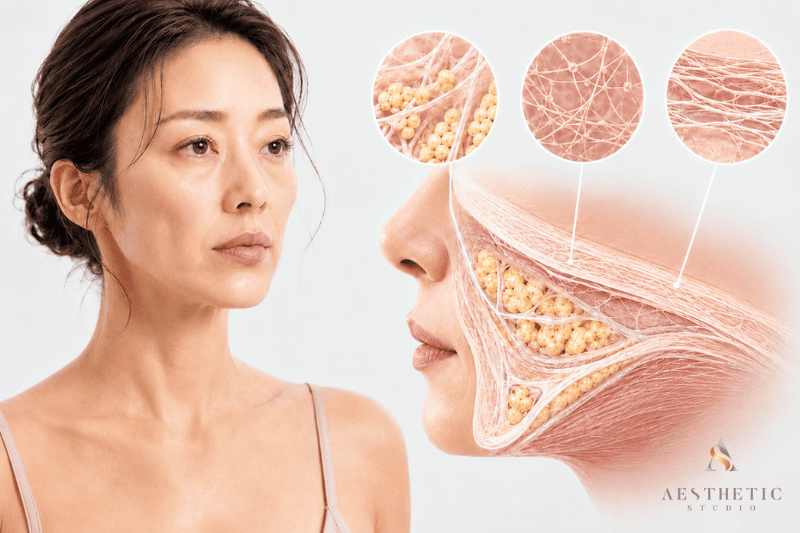
Facial hollowing and reduced structural support can become more noticeable following GLP-1 medication-assisted or significant weight loss. These changes are often described as Ozempic Face, although they are not limited to one medication or method of weight loss.
Sculptra, or poly-L-lactic acid (PLLA-SCA) collagen stimulator offers a regenerative approach to selected post-weight-loss facial changes. Instead of providing immediate volumisation alone, it encourages the body to produce new collagen, helping facial tissues regain support progressively.
Treatment is planned according to how weight loss has changed the face as a whole. By identifying where structural support has diminished — and where natural definition should be preserved — PLLA-SCA can help restore balance without attempting to replace every area of lost facial volume.
Benefits
How Can PLLA-SCA Help Ozempic Face
PLLA-SCA can help address facial deflation, reduced cheek support and declining skin firmness after GLP-1 medication-assisted or significant weight loss. Because improvement is created through the development of new collagen, the face can appear gradually more supported and refreshed while retaining its natural character.

Soften Temple Hollowing
Soften hollow-looking temples and depleted contours so the face appears less drawn while retaining natural definition.

Rebuild Cheek Support
Bring gentle structure back to depleted cheeks, creating healthier-looking contours without an excessively full or augmented appearance.

Improve Skin Firmness
Help skin appear firmer, smoother and more resilient by strengthening the collagen framework beneath its surface.

Restore Facial Balance
Create more harmonious transitions between facial contours for a refreshed appearance that still looks recognisably like you.
How It Works
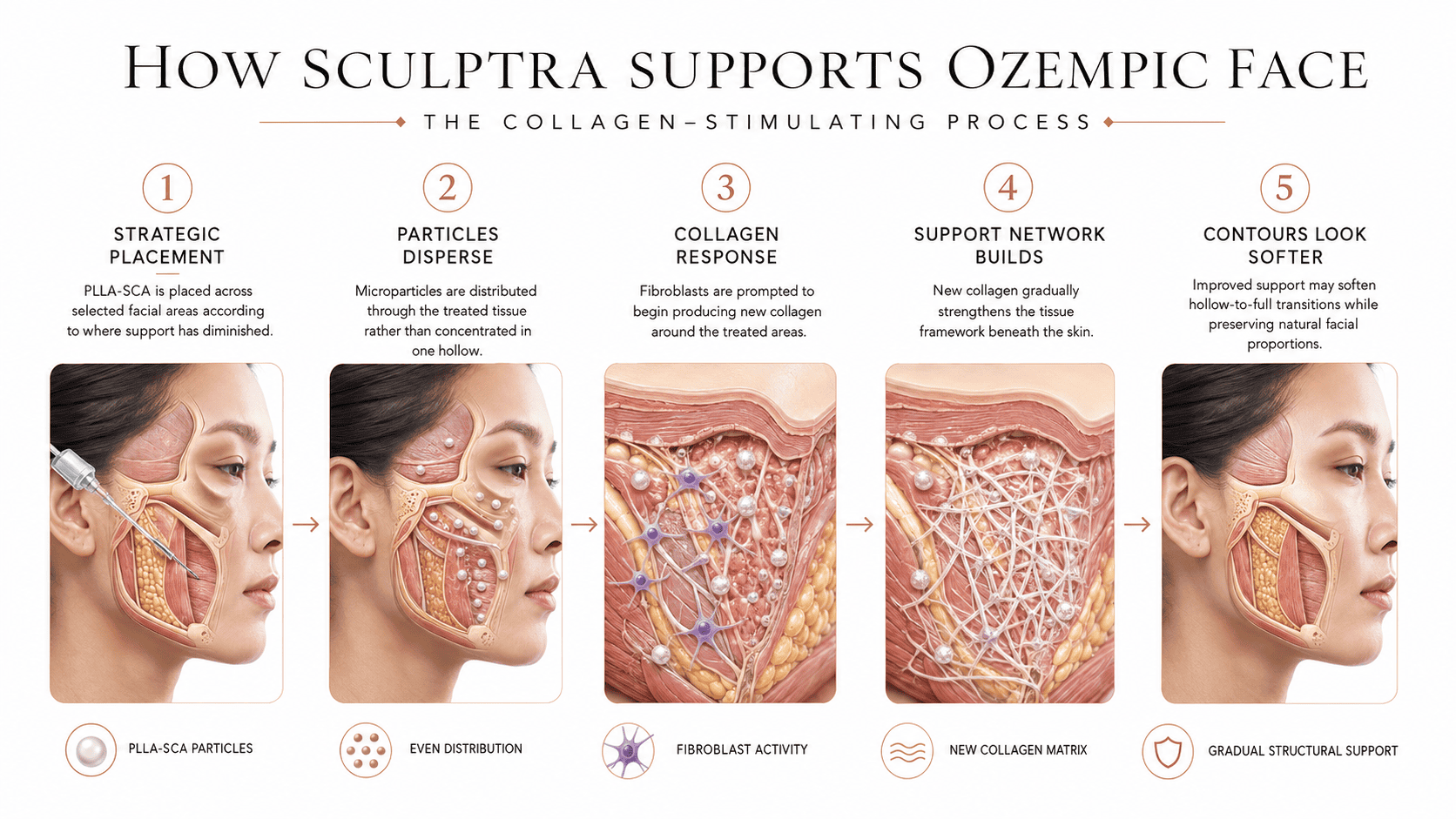
How PLLA-SCA Supports Ozempic Face
Facial changes after GLP-1 medication-assisted or significant weight loss are not always explained by lost volume alone. When facial fullness decreases, the overlying skin may also have less structural support, making contours appear more hollow, lax or poorly defined.
Initiating A Collagen Response
Injectable poly-L-lactic acid collagen stimulator (PLLA-SCA) works by initiating a gradual collagen response within treated tissues. Its effects develop progressively as newly produced collagen helps strengthen the skin’s underlying support structure.
Rebuilding Support Across The Face
Rather than filling each hollow individually, PLLA-SCA can be distributed strategically across selected areas of the face. This broader structural approach can help soften visible deflation, improve contour transitions and restore support where it has diminished following weight loss.
Allowing Changes To Develop Gradually
Collagen remodelling takes place over time rather than producing an immediate final result. This progressive process allows facial changes to emerge more subtly, reducing the likelihood of an abruptly altered or overfilled appearance.
When To Start
When Should You Start PLLA-SCA?
Timing matters because the face can continue changing throughout significant or GLP-1 medication-assisted weight loss. The aim is to assess facial changes early, while introducing treatment only when the direction and pace of weight loss have become sufficiently predictable.

Treating Too Early
When weight is falling rapidly, facial contours may still be evolving. Treating too aggressively at this stage could result in unnecessary or excessive correction.

Finding the Appropriate Window
As weight loss becomes more predictable, treatment can begin conservatively while emerging hollowing, reduced support and skin laxity can still be addressed progressively.

Waiting Until Changes Are Advanced
When hollowing and laxity become more established, collagen stimulation alone may not address every concern, and combination treatment may be required.
“The ideal window is often neither at the beginning nor strictly after weight loss is complete. It is when the direction of weight loss has become more predictable, facial changes can be assessed meaningfully, and treatment can still remain preventative rather than corrective.”
– Dr. Jonathan Lee, Aesthetic Physician
FAQ
Frequently Asked Questions About PLLA-SCA for Ozempic Face
How long do PLLA-SCA results last?
The effects of PLLA-SCA may remain visible for approximately two years in some patients, but the duration differs from person to person. Published clinical evidence has reported improvements lasting up to 25 months in studied indications; this does not mean every patient will experience the same longevity.
Results are influenced by the amount of collagen produced, the original degree of facial change, age, lifestyle, skin quality and whether weight continues to fluctuate. The face also continues to age naturally after treatment.
Maintenance should therefore be based on reassessment rather than a fixed calendar. Some patients may benefit from occasional treatment to support the existing result, while others may not require further intervention for a longer period. The objective is to respond to meaningful structural change — not to keep adding treatment simply because a certain period has passed.
When will I see results from PLLA-SCA?
PLLA-SCA results develop gradually and should not be judged from the immediate post-treatment appearance. Some early fullness may be visible because of the fluid used during the procedure, but this usually subsides and should not be mistaken for the final result.
Meaningful changes emerge as new collagen develops over the following weeks and months. Patients may first notice that depleted areas appear less hollow, the cheeks look better supported or the skin seems firmer. These changes tend to become apparent progressively rather than appearing all at once.
For someone who feels that weight loss has made their face look suddenly drawn or unfamiliar, this gradual development can be reassuring. The intention is not to create an abrupt transformation, but to help facial structure recover in a way that remains proportionate and recognisably their own.
Can PLLA-SCA help improve Ozempic face?
Yes, Sculptra (PLLA-SCA) can help when GLP-1 medication-assisted or significant weight loss has contributed to facial hollowing, reduced cheek support and less resilient-looking skin. It works by stimulating new collagen within selected facial tissues, gradually rebuilding some of the structural support that has diminished.
However, Ozempic face does not look the same in everyone. One person may notice hollow temples and flatter cheeks, while another may be more concerned about loose skin, deeper folds or changes around the jawline. PLLA-SCA is therefore most useful when collagen loss and broader structural deflation are meaningful parts of the concern.
It does not replace every facial fat compartment that has been lost, nor can it correct every degree of skin laxity. A facial assessment is needed to determine whether collagen stimulation alone is appropriate or should form part of a wider treatment plan.
Will PLLA-SCA make my face look overfilled?
PLLA-SCA does not have to create an overfilled appearance, but avoiding overcorrection depends heavily on appropriate patient selection, placement, dosage and timing.
This is particularly important during active weight loss. The face may still be changing, while collagen production from an earlier treatment continues to develop beneath the skin. Treating every new hollow immediately can mean responding to a moving target before the final effect of previous sessions is visible.
Our approach is therefore progressive. Treatment is planned around structural patterns rather than the goal of making the face “full” again, and sufficient time is allowed before deciding whether more is genuinely needed. This helps preserve the facial definition achieved through weight loss while restoring support where the face appears unnecessarily depleted.
What happens if I lose or regain weight after treatment?
Further weight loss or weight regain can change facial fat distribution and alter the contours surrounding the collagen produced through treatment. It does not simply remove the new collagen, but it may change how the overall result appears.
If substantial further weight loss is expected, treatment may be kept conservative so that evolving contours are not corrected too aggressively. If weight is regained, some facial fullness may return, although it may not return evenly or reproduce the face’s original shape.
This is why treatment should not be repeated according to a fixed formula. The face should be reassessed alongside changes in weight, skin laxity and facial proportions. Patients should also continue their prescribed GLP-1 medication plan with their treating medical provider; aesthetic concerns should not be used as a reason to alter or discontinue medication without medical advice.
Can PLLA-SCA tighten loose facial skin after weight loss?
PLLA-SCA may improve the firmness and support of mildly lax skin by stimulating new collagen, but it is not a surgical skin-lifting treatment. Its ability to help depends on whether the skin primarily appears under-supported or whether substantial excess skin and tissue descent are already present.
This is why timing and diagnosis matter. When facial deflation and early laxity occur together, rebuilding the underlying collagen framework may help the skin look smoother, firmer and better supported. When loose skin has become the dominant concern, collagen stimulation alone may not create the degree of lifting required.
In those cases, an energy-based treatment, targeted volumisation or surgical assessment may be more suitable. Combining more treatments is not automatically better; each recommendation should address a specific anatomical or tissue-level concern.
Does PLLA-SCA replace the facial fat lost during weight loss?
PLLA-SCA does not recreate the exact facial fat compartments lost during weight reduction. Instead, it encourages collagen production within treated tissues, helping improve structural support, contour and skin firmness over time.
This distinction matters. Attempting to replace every visible area of lost volume can make the face look disproportionately full and may obscure the definition achieved through weight loss. A more considered approach assesses which areas genuinely require support and which slimmer contours should be preserved.
For some patients, improving the collagen framework is enough to make the face appear less depleted and better supported. Others may have highly localised volume loss that requires a complementary treatment. The objective is not to return the face to its previous size, but to create a healthier-looking balance appropriate for its new proportions.